The Complete Electrical Systems Encyclopedia
This is the most comprehensive residential electrical guide published on the internet. Built from the National Electrical Code (NEC), Washington State L&I (Labor & Industries) regulations, and the raw field experience of independent Spokane electricians. Whether you're wondering if your aluminum wiring is a ticking time bomb or questioning a $15,000 "mandatory" panel upgrade—this encyclopedic deep-dive arms you with every technical detail you need to never get taken advantage of.
1. Understanding Electrical Fundamentals
Unlike plumbing where water is a physical substance you can see, electricity operates conceptually. To protect yourself from predatory pricing, you must understand the trifecta of electrical current:
- Voltage (V): The Pressure. Think of this as the water pressure in a pipe. The higher the voltage, the harder the electricity is "pushing" to get through the wire. Standard US outlets are 120V. Heavy appliances are 240V.
- Amperage (A): The Volume. Think of this as the actual volume of water flowing through the pipe. A standard bedroom circuit is 15 Amps. A massive electric furnace might draw 60 Amps.
- Wattage (W): The Total Power. This is Voltage multiplied by Amperage (V × A = W). It represents the total amount of energy being consumed. Your utility company bills you for Kilowatt-hours (kWh), which is 1,000 watts used continuously for one hour.
The Golden Rule of Resistance: Electricity constantly tries to return to its source (the earth) through the path of least resistance. When resistance is unexpectedly high (loose connections, oxidation, wire nuts falling off), the electricity has to "work harder" to jump the gap. This friction creates extreme heat—often exceeding 1,000°F—which is exactly how electrical fires start inside your walls.
2. The Service Entrance: The Handoff
The service entrance is the legal and physical dividing line between the utility company's infrastructure (Avista Utilities, Inland Power) and your personal property.
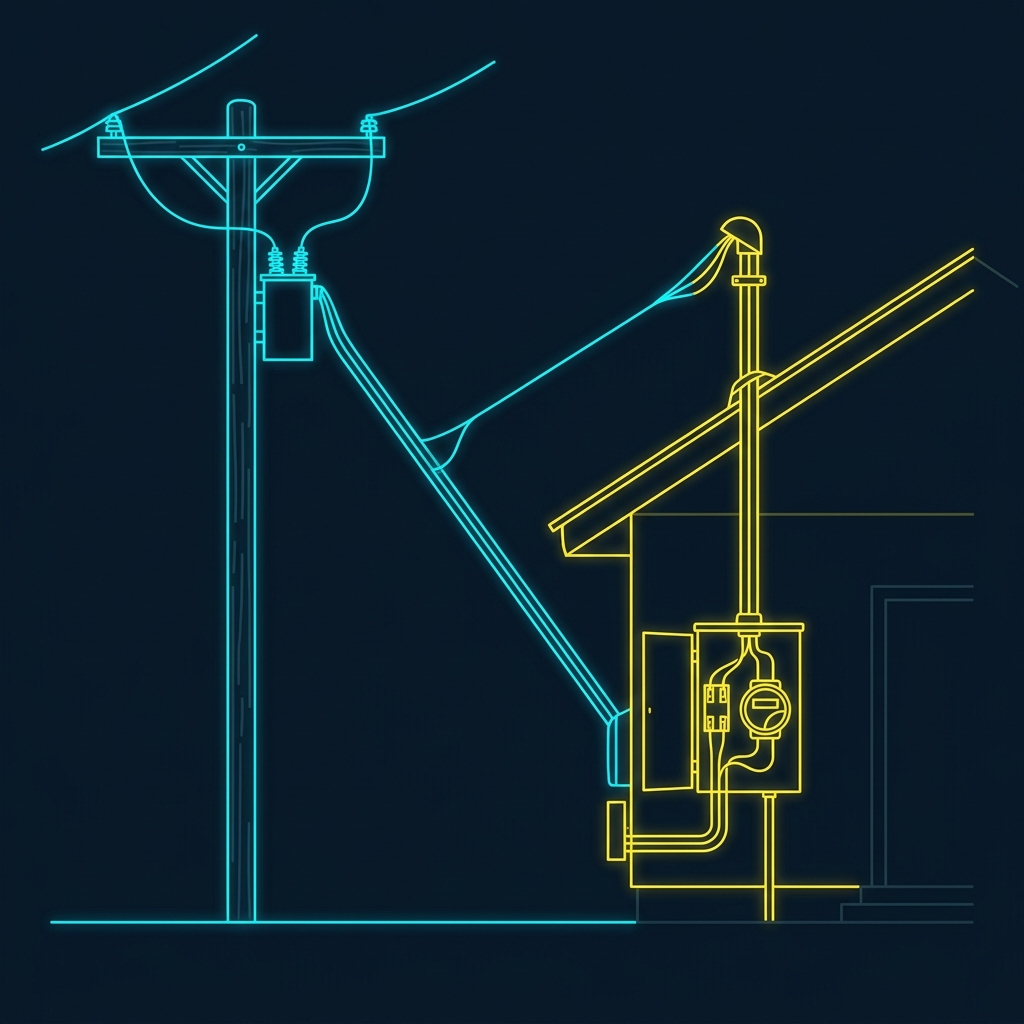
A. The Service Drop or Lateral
Power enters your property either overhead (via a Service Drop connecting to a mast/weatherhead on your roof) or underground (via a Service Lateral running in conduit). Overhead drops consist of three wires: two insulated "Hot" legs (120V each) wrapped around a bare "Neutral" messenger cable which also acts as the physical support wire. Underground laterals are notoriously expensive to repair because trenches must be dug 24-inches deep (code requirement) below the frost line.
B. The Meter Base
The electric meter literally bridges the utility grid to your home. While the utility company owns the green digital meter itself, you own the metal meter base/socket it plugs into. The meter tracks consumption via current transformers. Modern Spokane meters use RF (radio frequency) meshes to auto-report usage, eliminating the need for neighborhood meter readers.
C. The Main Disconnect
Starting with the 2020 NEC (adopted by WA L&I), all new residential services are legally required to have an exterior emergency disconnect OUTSIDE the house. This allows the fire department to instantly kill power to the entire structure without having to enter a burning building to find the basement panel. Older homes are grandfathered in and do not require this unless they undergo a heavy service upgrade.
3. The Breaker Panel: Anatomy & Dangers
The Service Panel (or Load Center) is the central brain of your home's infrastructure. Its singular purpose is safely dividing the massive electrical volume coming from the street into smaller, manageable "branch circuits" for your house.
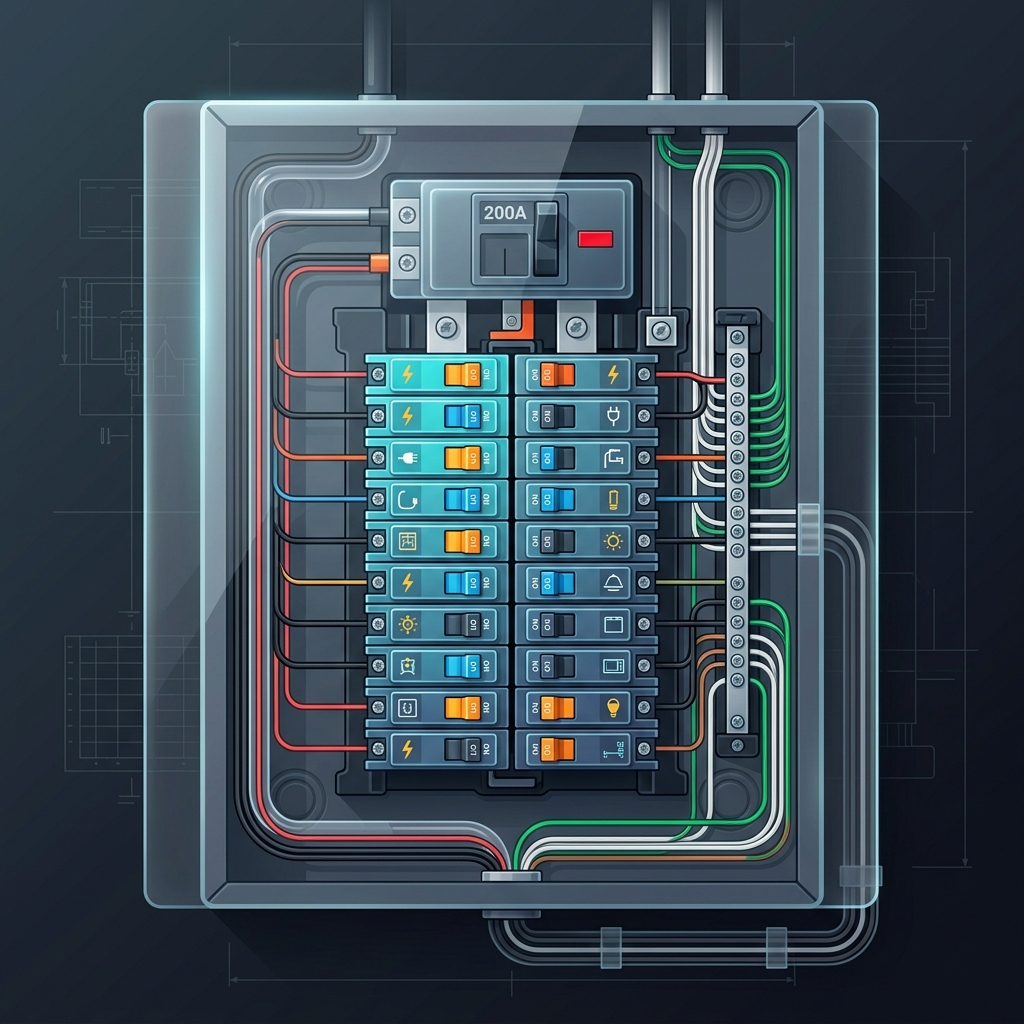
How Distribution Works
Inside the panel, two thick metal strips run vertically down the center. These are the Bus Bars. Each bus bar carries exactly 120 Volts. The bars alternate left-to-right structurally.
- Single-Pole Breakers: Standard breakers (15A or 20A) snap onto just one of these bus bars, delivering 120 Volts to your wall outlets and lights.
- Double-Pole Breakers: Large breakers (30A, 40A, 50A) physically snap onto both bus bars at the same time. Because they pull 120V from Bus A and 120V from Bus B simultaneously, they deliver the 240 Volts required for stoves, electric dryers, EV chargers, and HVAC systems.
- The Neutral/Ground Bar: Off to the side are massive strips of aluminum or copper where hundreds of white (Neutral) and bare copper (Ground) wires are screwed down. At your main panel, the Neutral and Ground bars are legally "bonded" together, allowing misdirected current to instantly return to the earth rather than shocking you.
CRITICAL WARNING: The Outdated Panel Crisis
Spokane's monumental housing boom in the 1960s and 1970s heavily utilized two extremely dangerous brands of load centers that lost their UL listings. If you have either of these, your home is at a severe risk of a structure fire during an electrical surge.
Federal Pacific Electric (FPE) "Stab-Lok"
FPE panels are notorious for a lethal engineering flaw: The breakers systematically fail to trip during over-current events. In CPSC testing, an astonishing 1 in 3 FPE Stab-Lok breakers failed to trip when overloaded, meaning instead of shutting off power, they simply melted in place and sent thousands of degrees of heat straight into the drywall. FPE also committed massive fraud to pass original UL testing. Verdict: Unconditional total replacement required.
Zinsco (and Sylvania-Zinsco)
Zinsco designed poor aluminum bus bars. Over time, the connection between the breaker and the bus bar oxidizes, creating immense resistance. The breaker essentially "arc welds" itself permanently to the bus bar. Once welded, it can never trip again, leading directly to catastrophic panel melt-downs. Verdict: Unconditional total replacement required.
True Cost Expectation for Panel Replacement
A standard 200-amp panel replacement (no service upgrade to the mast or underground trenching) by an independent, licensed journeyman electrician in Spokane should cost $2,500 to $4,000, including permits. Corporate, private-equity-backed franchises systematically quote $8,000 to $18,000+ for the exact identical hardware and labor. Always obtain three independent bids.
4. 100 Years of Wiring in Spokane
Because Spokane features historic homes in the South Hill, mid-century ranches in the Valley, and modern build-outs in the North Side, your house could contain completely different wiring technology depending on the decade a specific room was built or remodeled.
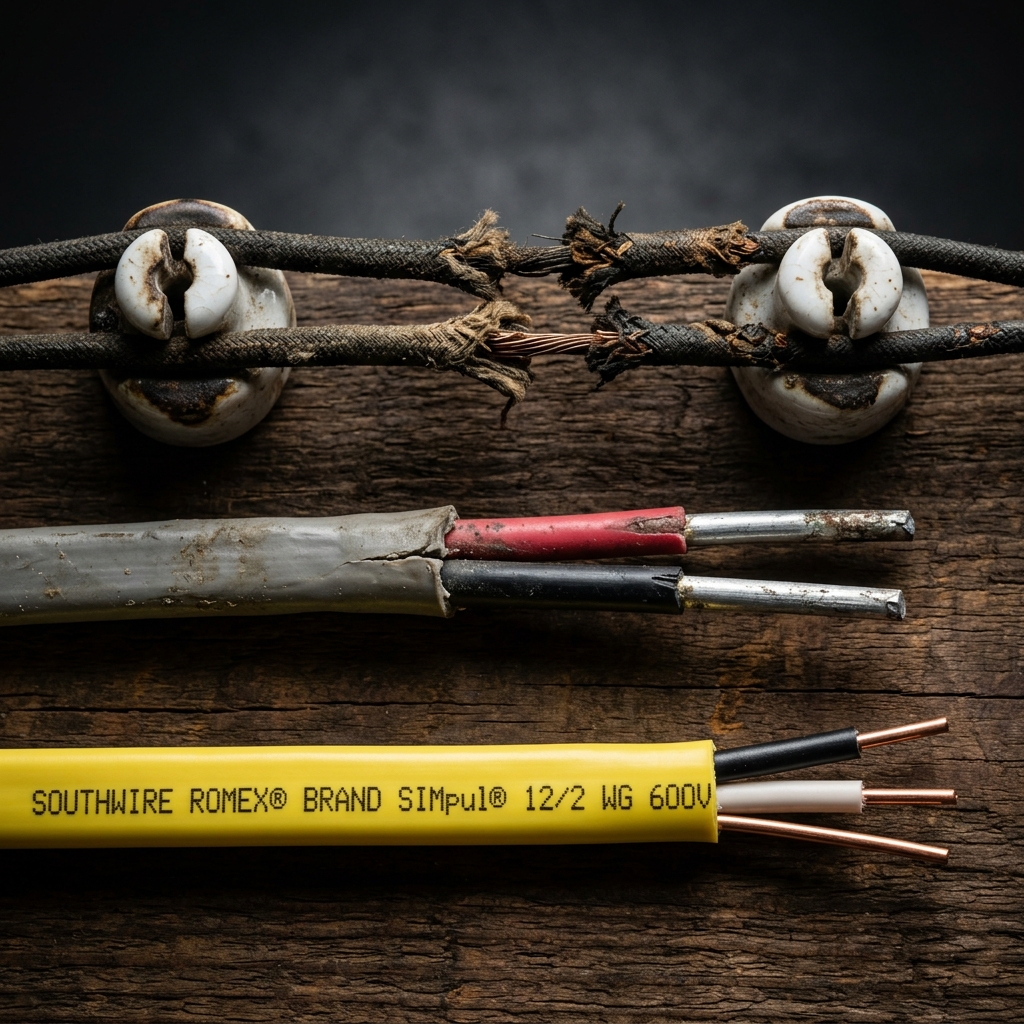
Knob and Tube (K&T) (1890–1940s)
The original electrical grid. Individual hot and neutral wires are suspended independently on porcelain "knobs" nailed to the joists, and run strictly through porcelain "tubes" whenever they pass through wood framing.
- The Danger: It contains absolutely ZERO ground wire. There is no earth path for faults. Secondly, the rubber and cloth insulation has fully dried out and turns to dust at a mere touch today, leaving naked, electrified copper hanging in your attic.
- The Heat Trap: K&T was designed to dissipate heat into the open air. Modern homeowners almost always blow fiberglass or cellulose insulation directly over K&T runs in the attic. The wires heat up under the insulation, melt the remaining rotting rubber, and ignite the wood joists.
- Insurance Impact: Most major home insurance carriers in Washington State will refuse to underwrite a policy, or cancel a policy entirely, if active Knob & Tube wiring is discovered during an inspection.
Cloth-Covered Romex / BX Cable (1950s–1960s)
The first generation of bundled cables. Cloth-covered "Romex" looked like silver or black woven fabric. Often, earlier versions (1940s-1950s) still lacked a ground wire. By the mid-1960s, early versions of PVC (plastic) insulation began covering the internal conductors, while the outer sheath remained cloth.
Condition: Generally safer than K&T as long as it has a ground wire, but the cloth is highly susceptible to rodent damage. Mice love to chew the fabric, exposing the bare copper beneath.
Solid Aluminum Wiring (1965–1973)
During the Vietnam War, copper prices experienced exponential inflation. To cut costs, homebuilders across North America switched to solid aluminum wiring (look for "AL" printed on the plastic sheathing).
- The Oxidation Problem: Unlike copper, when aluminum oxidizes, the oxidation layer becomes a perfect insulator (it stops conducting electricity).
- The Compression Problem: Aluminum expands vigorously when hot and shrinks when cold. After years of electricity flowing, this expansion/contraction cycle physically loosens the terminal screws on outlets and switches.
- The Danger: The loose screw creates an air gap. The electricity arcs across the gap. The arcing creates oxidation. The oxidation creates massive resistance. The resistance creates temperatures exceeding 1,500°F. The plastic outlet melts, and the drywall ignites.
Modern Copper NM-B (Romex) (1980s–Present)
Non-Metallic Building cable (NM-B). Features dense thermoplastic PVC jackets surrounding independent hot, neutral, and bare copper grounding wires. Extremely durable, heat-resistant (modern NM-B is rated to 90°C/194°F), and exceptionally safe. Easily identified by colors (White = 14 gauge, Yellow = 12 gauge, Orange = 10 gauge).
5. Wire Gauges & Ampacity Limits
Ampacity is the maximum amount of current a wire can safely carry before its plastic insulation begins melting. In the American Wire Gauge (AWG) system, the smaller the number, the thicker the wire.
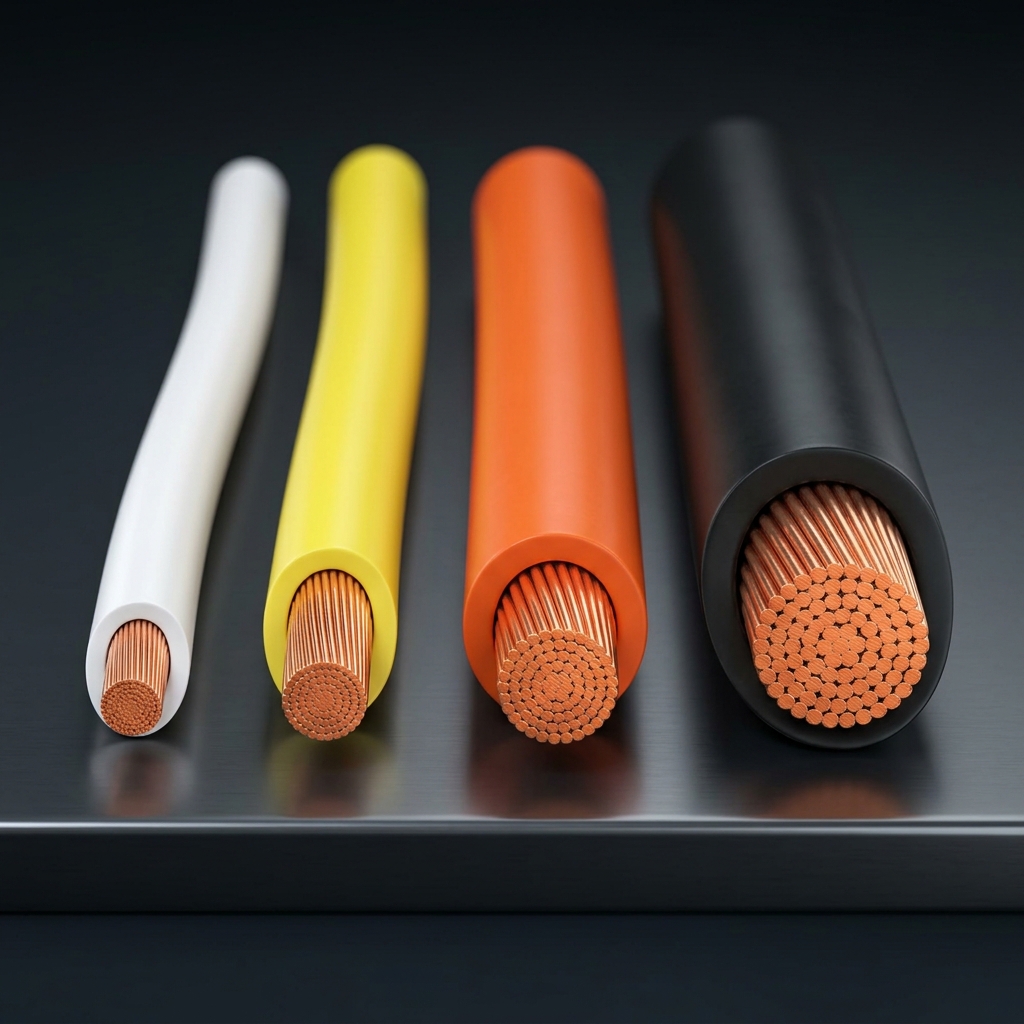
| AWG Gauge | Max Ampacity | Breaker Size | Common Household Applications |
|---|---|---|---|
| 14 Gauge (White) | 15 Amps | 15-Amp Pole | Recessed lighting, bedroom outlets, smoke detectors. |
| 12 Gauge (Yellow) | 20 Amps | 20-Amp Pole | Kitchen countertop appliances, garage outlets, bathroom vanity outlets. |
| 10 Gauge (Orange) | 30 Amps | 30-Amp Double Pole | Electric water heaters, AC condensers, standard electric dryers. |
| 8 Gauge (Black) | 40 Amps | 40-Amp Double Pole | Electric ovens, hot tubs, heavy AC units. |
| 6 Gauge (Black) | 55-60 Amps | 50/60-Amp Double Pole | Electric furnaces, massive sub-panels, Level 2 EV Chargers. |
The Deadly DIY Mistake: NEVER put a 20-Amp breaker on a circuit wired with 14-Gauge wire. The wire will melt and ignite the drywall long before the breaker ever recognizes the 20-Amp limit has been breached.
6. System Protection: GFCI, AFCI & Grounding
Standard circuit breakers are engineered specifically to protect the copper wire inside the wall from melting. They are drastically too slow and too insensitive to protect a human heart from lethal electrocution. That requires intelligent, secondary mechanisms.
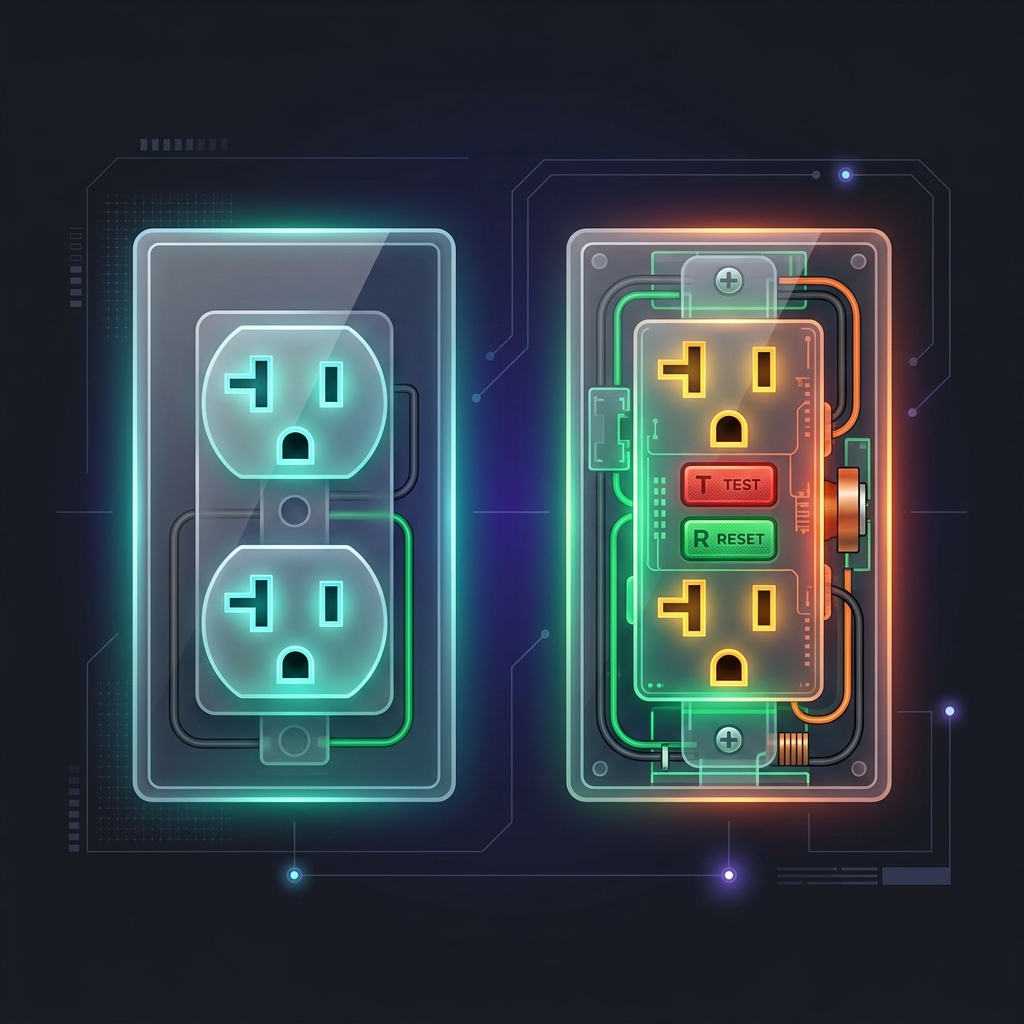
Ground Fault Circuit Interrupters (GFCI)
Required by code in any "wet" location: Kitchens, bathrooms, garages, basements, and all exterior receptacles. A GFCI acts like an extremely precise scale.
- It measures the electrons leaving the panel on the Hot wire, and meticulously weighs them against the electrons returning on the Neutral wire.
- If the difference is greater than 0.005 Amps (5 milliamperes), the GFCI assumes the missing electricity is flowing through a person or a puddle of water.
- It physically breaks the circuit in under 0.025 seconds (1/40th of a second), which is faster than a human heartbeat, eliminating lethal shock.
Pro Tip: A single GFCI outlet can protect standard "dumb" outlets downstream from it provided they are wired into the GFCI's "LOAD" terminals.
Arc Fault Circuit Interrupters (AFCI)
Required by modern NEC code in almost all "dry" living spaces (bedrooms, living rooms, hallways). Standard breakers only read raw volume (amperage). If a nail gets driven through a wire—or a frayed vacuum cord starts sparking—it might only draw 5 Amps. A standard 15 Amp breaker will completely ignore it, while the sparks silently ignite the wood framing.
AFCIs contain microprocessor chips that act as highly advanced microphones. They physically "listen" to the high-frequency electronic noise flowing through the wire. If they hear the specific, erratic oscillating signature of an electrical arc, they kill the circuit instantly, preventing house fires before they erupt.
Whole House Grounding (The Ufer vs Rods)
The ground wire is an emergency escape tunnel for runaway electricity. To make it work, the entire system must be physically anchored to the Earth. Historically, this was done by driving two 8-foot copper rods into the soil outside the panel. Modern Spokane construction utilizes the Ufer Ground (Concrete-Encased Electrode), tying the system's ground directly into the massive steel rebar grid buried inside the home's concrete foundation—providing infinitely superior dispersion of lightning strikes and massive utility surges.
7. Washington L&I Codes & Permits
Electrical work in Spokane is governed stringently. Unlike drywall or trim carpentry, illegal electrical work renders a home completely unsafe and creates massive liabilities during real estate transactions.
- The Homeowner Exemption: In Washington State, you are legally allowed to perform your own electrical work (including rewiring and panel swaps) if and only if you own the property AND it is your primary residence. You cannot legally do electrical work on rental properties or house flips without being an 02 (Residential) or 01 (Commercial) licensed Journeyman.
- Permitting Requirements: Washington Labor & Industries (L&I) requires a paid permit for almost everything beyond literally changing a lightbulb or swapping a like-for-like broken outlet/switch plug. Adding new circuits or modifying panel loads absolutely requires an L&I permit.
- The Inspection Process: Hardwired projects require two L&I inspections: A "Rough-In Inspection" (conducted before drywall is installed, so inspectors can see wire routing, box mounting, and staples), and a "Final Inspection" (after drywall, testing outlets for polarity and GFCI response).
8. The Extortion Tactics Library
Over the last decade, high-pressure private equity firms have acquired multiple legacy HVAC and Electrical brands across Spokane. They hire "Selling Techs" who receive weeks of psychological sales training to turn $150 service calls into $15,000 financing contracts. Here is exactly what they will say to you, and how to verify if they are lying.
The "Old Code is Illegal Code" Lie
The Tactic: You call them out to replace a single, dead 15-Amp breaker that keeps tripping. The tech opens the panel, shakes his head dramatically, and says, "I literally can't touch this panel. L&I regulations state your entire system is illegal under the new 2023 NEC code. Before I can replace this $20 breaker, state law forces me to upgrade your whole 150-amp panel to a 200-amp smart-panel."
The Reality: Electrical code is not retroactive. Existing installations that passed inspection at the time of their construction are "grandfathered in" and legally allowed to remain indefinitely. You are only required to bring a specific component up to modern code if you are actively modifying or replacing that specific component. Washington L&I does absolutely not mandate a $5,000 panel swap to legally swap an existing broken breaker of the same capacity.
The "200-Amp Upgrade" Necessity Fraud
The Tactic: To support a new hot tub or induction stove, the corporate tech claims your current 100-Amp or 150-Amp panel is "too small" and "overloaded," forcing a heavy service upgrade costing $8,000+.
The Reality: A home's capacity is governed by NEC Article 220 Load Calculations, not by simply counting the numbers on the breakers. Because you don't run your AC, dryer, oven, and hot tub at 100% maximum capacity 24 hours a day simultaneously, a 100-Amp service is perfectly capable of handling a surprisingly heavy modern footprint. Only a hard mathematical load calculation can definitively prove an upgrade is required. Furthermore, smart-splitters (like the NeoCharge) can allow an EV charger and an electric Dryer to share a single 30A circuit safely, entirely avoiding $8,000 service upgrades.
The $18,000 Aluminum Demolition Trap
The Tactic: During a home inspection, aluminum wiring is discovered. The tech claims it's an immediate, catastrophic risk and presents high-pressure financing for an $18,000 whole-house copper rewire requiring massive drywall demolition and a week of displacement.
The Reality: Aluminum wire is an excellent conductor—the extreme fire hazard exists only at the termination points. An honest, independent electrician will use CPSC-approved AlumiConn terminal blocks or explicitly rated Purple wire nuts to "pigtail" a short piece of solid Copper to the end of every Aluminum wire behind every outlet. The entire hazard is permanently resolved for $2,000 to $3,000, with zero drywall damage.
The "Gold Membership" Surge Protector Hustle
The Tactic: After you sign up for their $19/month "Priority Membership," they perform a "free annual safety inspection." They immediately insist you need a $900 Whole House Surge Protector to safeguard your plasma TVs.
The Reality: Whole-house surge protectors (SPDs) are actually brilliant investments, and are now legally required by NEC 2020 on all new service installations. However, a top-tier Type-2 SPD (like the Siemens FS140) costs exactly $120. It requires zero drywall work, no new wire runs, and takes an electrician exactly 15 minutes to clip it into a standard double-pole breaker inside the panel. Charging $900 for a 15-minute, $120 part installation is pure predatory pricing.