The Complete Plumbing Systems Encyclopedia
This is the most comprehensive residential plumbing guide published on the internet. Built from the Uniform Plumbing Code (UPC), EPA drinking water standards, Washington State building code, and the raw field experience of independent Spokane plumbers. Whether you're dealing with a burst pipe at 2 AM in January or wondering if that $4,800 re-pipe estimate is legitimate — this guide arms you with every technical detail you need to never get taken advantage of again.
Trunk-and-Branch (Traditional): One main line feeds smaller branch lines to each fixture. If one branch leaks, you must shut off water to the entire house. This is what 95% of Spokane homes over 20 years old have.
Manifold System (Modern): A central PEX manifold (looks like a brass bar with multiple ports) distributes individual "home run" lines to each fixture. Each port has its own shutoff valve. If one fixture leaks, you shut off only that fixture — the rest of the house continues operating. This is the gold standard for modern re-pipes and new construction.
Bottom Line: If you're paying for a full re-pipe anyway, insist on a manifold system. The material cost difference is minimal ($200-$400 more), but the lifetime convenience and diagnostic advantage is immeasurable.
3. Pipe Materials Intelligence
The material transporting water inside your walls dictates everything: maximum operating pressure, corrosion resistance, freeze tolerance, lifespan, and the cost of repair. Spokane's housing stock contains virtually every pipe material ever manufactured. Knowing what you have is the first step to accurate diagnosis and fair pricing.
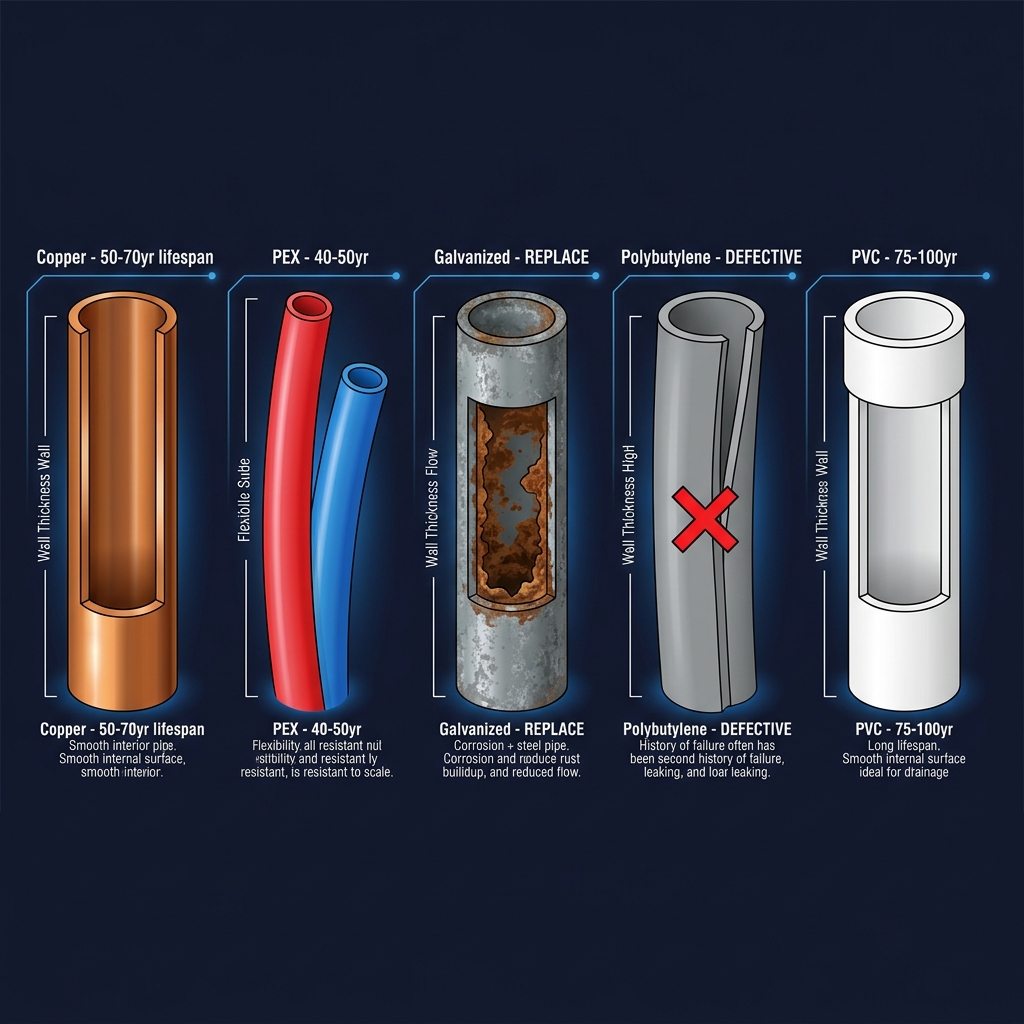
Era: 1960s – Present
Lifespan: 50-70 Years
The Unfiltered Truth: The gold standard for durability. Type L is standard residential. Type K (thickest wall) is used for underground service lines. Copper is bacteriostatic (inhibits bacterial growth), handles high pressure, and is fully recyclable. Downside: expensive ($3-$8/ft installed), rigid (requires fittings at every turn), and reactive to acidic water — causing pinhole leaks over decades of exposure.
Era: 1990s – Present
Lifespan: 40-50 Years
The Unfiltered Truth: The modern workhorse. Flexible, cheap ($0.50-$1.50/ft), and expands up to 15% during freezing — critical for Spokane's brutal winters. Comes in color-coded rolls (red = hot, blue = cold, white = either). Cannot be used outdoors (UV degradation) or for gas lines. Almost exclusively used in modern Spokane re-pipes.
Era: 1980s – Present
Lifespan: 25-40 Years
The Unfiltered Truth: Rigid cream-colored plastic used for hot and cold supply. Cheaper than copper, but becomes brittle with age and can shatter from impact. If your CPVC pipes are yellowed and you can see hairline crazing (micro-cracks), they are nearing end-of-life.
Era: Pre-1970s
Lifespan: 30-50 Years
The Unfiltered Truth: COMMON IN OLDER SPOKANE HOMES. Heavy threaded steel pipes with a zinc coating. The zinc erodes from the inside over decades, exposing raw steel to constant water exposure. The pipes rust internally, building up mineral deposits that progressively choke water flow. Symptom: low water pressure, brown/rusty water when first turning on a tap, and visible corrosion at threaded joints. If your South Hill bungalow was built before 1960, there's a strong chance you have galvanized pipes that need replacement.
Era: 1978 – 1995
Lifespan: 10-15 Years
The Unfiltered Truth: CRITICAL DEFECT — CLASS ACTION LAWSUIT MATERIAL. Gray, flexible plastic pipes installed in millions of homes during the '80s housing boom. Polybutylene reacts chemically with chlorine and chloramine (present in all municipal water), causing the pipe walls to become micro-fractured and burst catastrophically without warning. If you see gray flexible pipes with copper crimped fittings at your water heater or manifold — get them replaced immediately. Insurance companies are increasingly refusing to cover PB-related water damage.
Era: Pre-1930s
Lifespan: 100+ Years
The Unfiltered Truth: HEALTH HAZARD. A small number of Spokane homes built before 1930 may still have lead service lines connecting to the city main, or lead solder on copper joints (banned in 1986). Lead is a cumulative neurotoxin with no safe exposure level. Contact Spokane's water utility for a free service line material verification if your home predates 1940.
Galvanic Corrosion: The Hidden Destroyer
When two dissimilar metals touch in the presence of water (an electrolyte), the less noble metal corrodes at an accelerated rate. This electrochemical reaction — called galvanic corrosion — is the #1 reason copper-to-galvanized steel transitions fail. In Spokane, this is extremely common: a 1960s home with original galvanized pipes that had a kitchen remodel in the 1990s using copper. At every copper-to-steel joint, the steel is being eaten from the inside out at 5-10x the normal corrosion rate.
The Fix: A dielectric union or brass transition fitting creates a barrier between the two metals, stopping the electrochemical reaction. Cost: $15-$30 per fitting. Any plumber who connects copper directly to galvanized steel without a dielectric union is either incompetent or doesn't care about your long-term outcome.
Some plumbers will recommend replacing only the visible galvanized pipes (in the basement/crawl space) and leaving the pipes inside the walls untouched. This is like replacing only the rusty exhaust pipe while ignoring the corroded engine block. The pipes hidden in your walls are the same age and same material — they'll fail next. Insist on a full re-pipe or don't bother. Half-measures mean paying twice.
4. The Drain-Waste-Vent (DWV) System
If the supply system is your home's arteries (pressurized, clean), the DWV system is the veins (gravity-fed, waste). Every drop of water that enters your home must leave through this system. It is governed by three ironclad physical laws: gravity, atmospheric pressure, and the water seal.
The Three Components
Drain Lines
Horizontal (slightly sloped at ¼ inch per foot) pipes that carry wastewater from fixtures to the main sewer trunk. Undersized or poorly sloped drains cause chronic slow drainage and sediment buildup.
Waste Lines
Vertical pipes (called "stacks") that carry waste downward from upper floors to the building drain in the basement or crawl space. The main waste stack is typically 3-4 inches in diameter and handles toilets.
Vent Lines
Pipes that extend from the drain system through the roof, allowing air to enter and equalize pressure. Without vents, draining water creates a vacuum that siphons water out of P-traps, allowing sewer gas into the house.
Look under any sink in your home. That U-shaped bend in the drain pipe is a P-trap. Its sole purpose is to hold approximately 2 inches of standing water at all times, creating an airtight seal between the drain opening and the sewer system. This water seal prevents methane, hydrogen sulfide, and other toxic sewer gases from entering your living space.
Why do rarely-used drains smell? If a guest bathroom or basement floor drain hasn't been used in months, the water in the P-trap slowly evaporates. Once the seal breaks, sewer gas enters freely. Fix: pour a cup of water down every drain you haven't used in 30+ days. For floor drains, pour a tablespoon of mineral oil on top — it floats on the water surface and prevents evaporation for months.
Gurgling drains: If your sink gurgles when the toilet is flushed (or vice versa), the vent serving that fixture is blocked or improperly sized. The draining water is pulling air backward through the P-trap of an adjacent fixture. This is a venting deficiency, not a clog — and snaking the drain will not fix it.
Secondary Drains (1.5" – 2" pipes): These individual drop lines run from each sink, shower, tub, and washing machine to the main stack. When these clog, the backup is localized. Your kitchen sink backs up but the bathroom flushes fine? The blockage is in the secondary kitchen drop line. Typical clearing cost: $100-$200.
The Main Sewer Trunk (3" – 4" pipe): The massive pipe buried beneath your foundation (or running horizontal in the crawl space) that collects wastewater from every secondary drain and routes it to the Spokane city sewer or your septic tank.
Symptom of Main Line Clog: You flush an upstairs toilet and sewage bubbles up through your basement shower drain or floor drain. Or you run the washing machine and the downstairs toilet overflows. These are system-wide symptoms indicating the main trunk is completely blocked — usually by tree roots, collapsed pipe, or accumulated grease/paper buildup. Typical main line clearing: $200-$500 with a motorized auger.
For main line clogs caused by organic mass (toilet paper, hair) or minor root intrusions, a standard $200-$350 motorized steel auger (a "snake") is usually sufficient. Predatory companies will immediately claim a snake cannot clear it and mandate a $900-$1,500 "Hydro-Jetting" service. Hydro-jetting uses 4,000 PSI water to scrape pipes clean — it's highly effective for deep grease traps and severe root infestations, but it is usually gross overkill for a standard residential clog. Always try a snake first.
5. Water Heaters: Tank vs. Tankless Engineering
The water heater is the single most expensive plumbing appliance in your home and the #1 source of emergency plumbing calls in Spokane during winter. Understanding the engineering differences between tank and tankless units prevents you from being upsold a $6,000 system when a $1,200 replacement does the job.
Tank (Traditional): Stores 40-80 gallons of pre-heated water in an insulated tank, maintaining temperature 24/7
Tankless (On-Demand): Heats water instantly as it passes through a heat exchanger on demand — no stored water
Tank (Traditional): 10-15 years (8-12 with Spokane's mineral-heavy water)
Tankless (On-Demand): 20-25 years with annual descaling
Tank (Traditional): $1,000 - $2,000 (gas) / $800 - $1,500 (electric)
Tankless (On-Demand): $3,500 - $6,000 including gas line and venting upgrades
Tank (Traditional): Higher — constantly maintaining tank temperature (standby heat loss)
Tankless (On-Demand): 20-30% lower annual energy cost — only fires when water flows
Tank (Traditional): Can supply multiple fixtures simultaneously until tank depletes
Tankless (On-Demand): Limited GPM output — running 2 showers + dishwasher simultaneously may exceed capacity
Tank (Traditional): Ground water enters at 38°F in January; tank works harder
Tankless (On-Demand): Must heat 38°F water to 120°F instantly — requires high-BTU unit to perform in cold climates
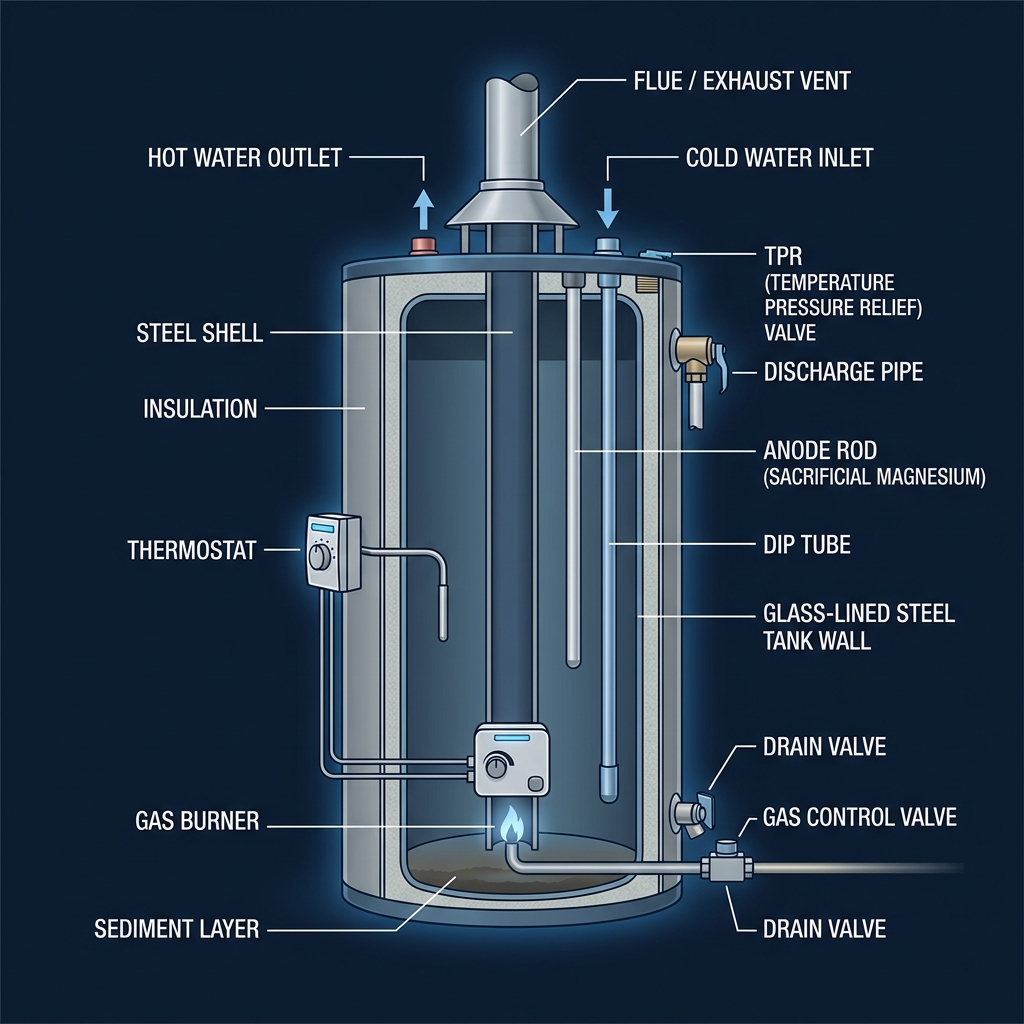
Inside every tank water heater is a sacrificial anode rod — a metal rod (usually magnesium or aluminum) that corrodes intentionally so the tank walls don't have to. The anode rod attracts corrosive minerals in the water to itself, dissolving over 3-5 years. Once the rod is depleted, the corrosive minerals redirect to the steel tank lining, accelerating interior rust and eventual tank failure.
Maintenance: Have the anode rod inspected every 3 years. If it's more than 50% depleted (visible pitting, reduced diameter), replace it. Cost: $25-$50 for the part, $150-$250 for professional installation. This single action can extend tank life by 3-5 years — a dramatically better ROI than a premature $2,000 full tank replacement.
Spokane-Specific: The Spokane Aquifer produces moderately hard water (120-180 PPM hardness). Mineral-heavy water consumes anode rods faster. If your water is particularly hard (test with a $10 kit from Home Depot), consider upgrading to a powered anode rod ($80-$120) that uses low-voltage current instead of sacrificial corrosion and never needs replacement.
The Temperature and Pressure Relief (TPR) valve is a brass spring-loaded mechanism mounted on the side or top of the tank. If the water temperature exceeds 210°F or internal pressure exceeds 150 PSI (due to a stuck thermostat, thermal expansion, or PRV failure), the TPR valve automatically pops open and releases water/steam to prevent a catastrophic tank explosion.
A water heater with a disabled or plugged TPR valve is a literal bomb. Superheated water under extreme pressure can flash to steam instantaneously if the tank ruptures, launching the tank through floors and ceilings with explosive force. MythBusters famously demonstrated this — a 50-gallon water heater rocketed 500 feet into the air.
Test annually: Lift the small lever on the TPR valve briefly. Water should discharge from the overflow pipe. If nothing comes out or it drips continuously, the valve is stuck/failed and must be replaced immediately ($20 part, $80-$150 installed).
Minerals in Spokane's water settle at the bottom of the tank, forming a layer of calcium carbonate sediment. This insulating layer forces the burner to work harder, reduces efficiency, creates popping/rumbling noises, and eventually cracks the glass lining of the tank. Flush your water heater annually by attaching a garden hose to the drain valve at the bottom and draining 2-3 gallons until the water runs clear. This 15-minute DIY task costs $0 and can add years to your tank's service life.
6. Fixtures, Valves & Shutoffs
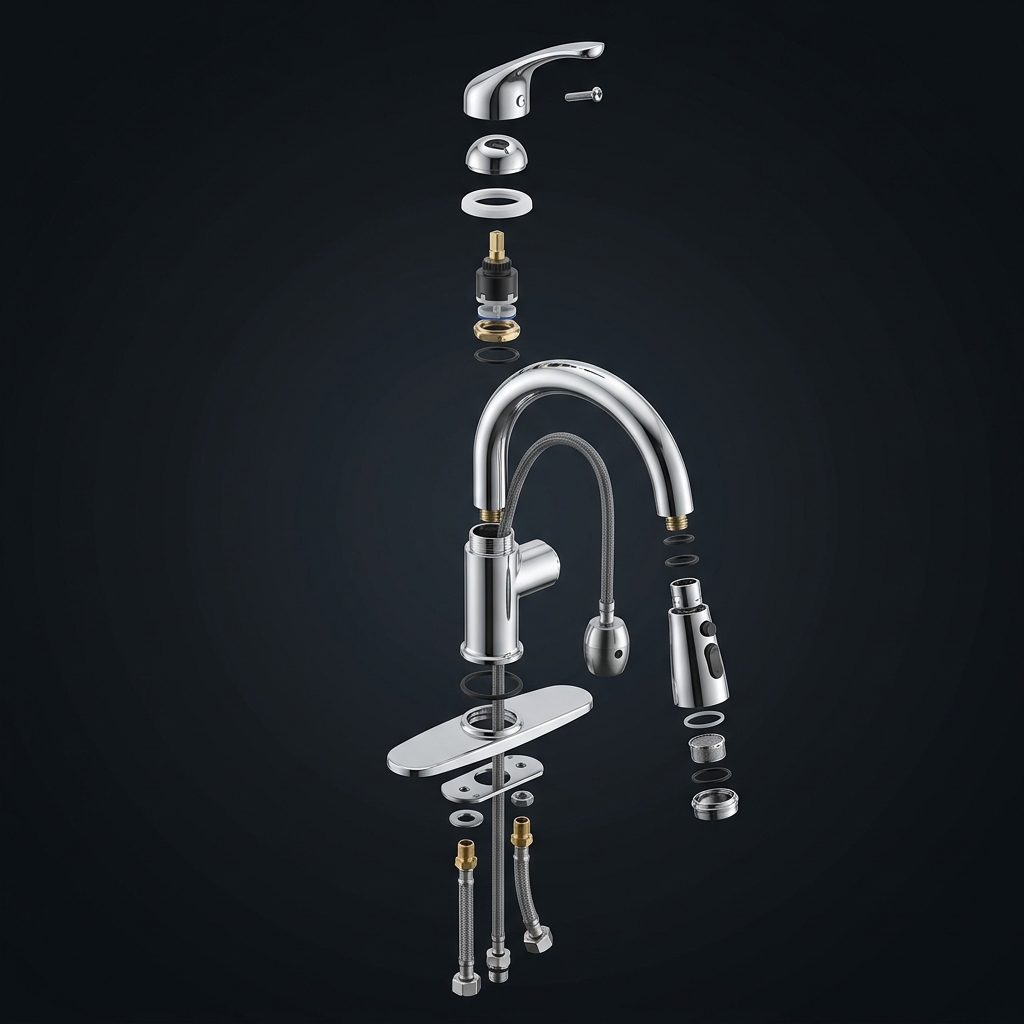
Understanding the valve hierarchy in your home is mission-critical during an emergency. When water is spraying from a broken supply line at 3 AM, you do not have time to read a manual.
Location: Where service line enters house (basement/crawl space)
What It Controls: ALL water to the entire home. Turn this off first in any emergency.
Location: At the water meter vault near the curb
What It Controls: Water before it reaches your house. Requires a meter key (T-handle wrench). Use if main shutoff fails.
Location: Under sinks, behind toilets, behind washing machine
What It Controls: Individual fixture water supply. Turn left (counterclockwise) to close. Oval handles = gate valve. Lever handles = ball valve (superior).
Location: Main line, just after the main shutoff
What It Controls: Reduces incoming municipal pressure from 80-120 PSI to a safe 50-65 PSI.
Location: Exterior walls
What It Controls: Outdoor water supply for garden hoses, irrigation. Must have interior shutoff valves for winterization.
Location: Cold supply line directly above the water heater
What It Controls: Isolates water to the heater for maintenance or emergency. Also has a gas shutoff (yellow handle) or breaker (electric).
Gate valves (the oval-handle type found under most older Spokane home sinks) seize up when not used. Mineral deposits bond the gate to the valve body, making it impossible to turn during an emergency. Once a year, turn every shutoff valve in the house fully closed, then fully open. If a gate valve is stuck or leaks when operated, replace it with a quarter-turn ball valve ($15 part, $75-$150 installed) — they never seize and provide instant positive shutoff.
7. Spokane Seasonal Plumbing: Winterization & Spring Thaw
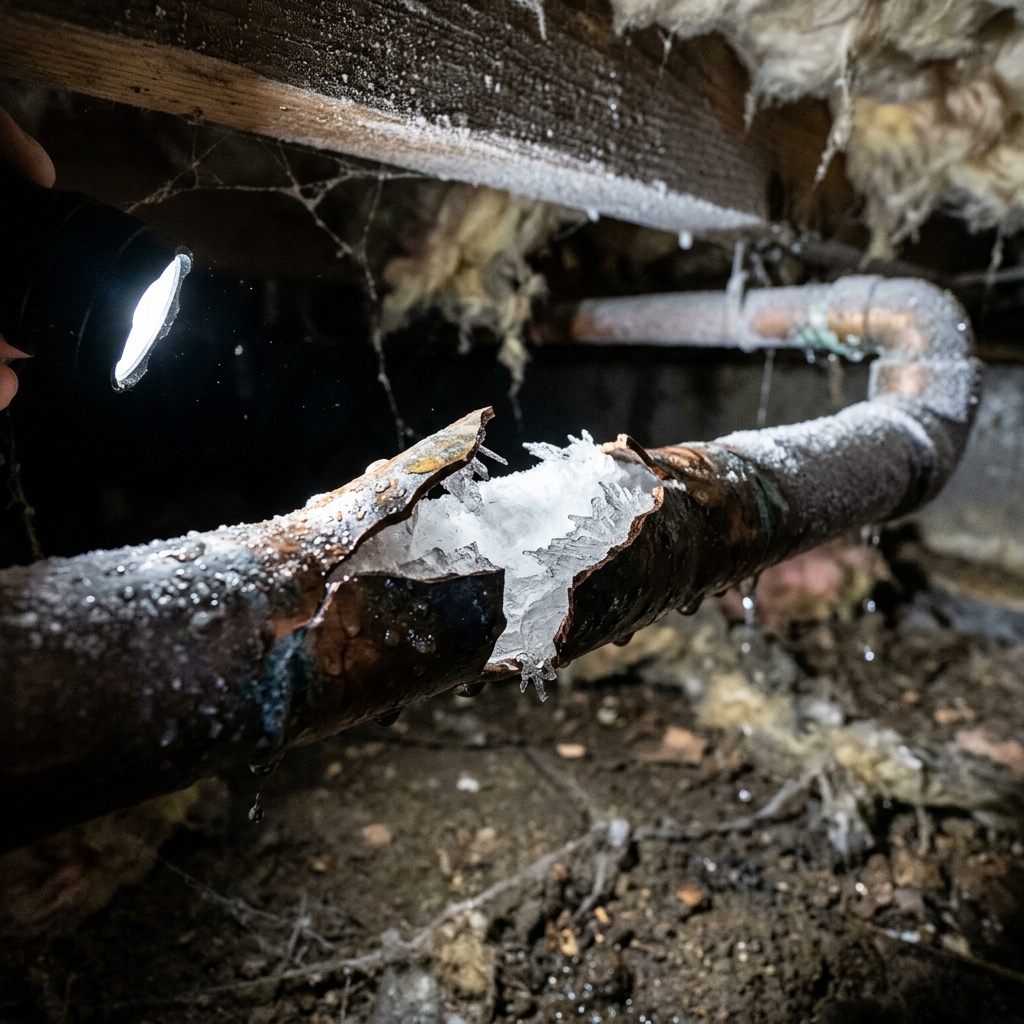
Spokane's climate is the defining variable in local plumbing. Average January temperatures hover around 25°F (-4°C), with cold snaps regularly plunging below 0°F (-18°C). This freeze-thaw cycle inflicts annual damage on residential plumbing systems that warmer-climate homeowners never experience.
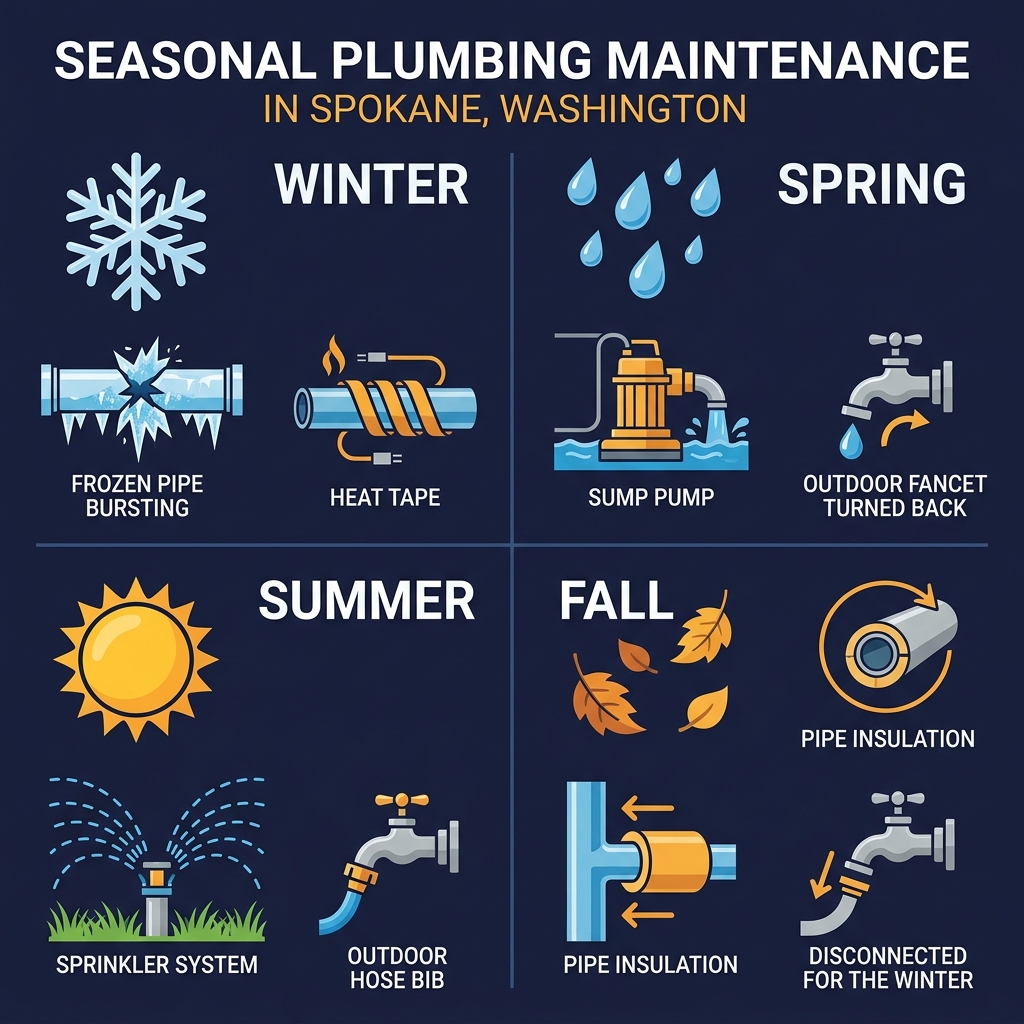
❄️ Winter Preparation Checklist (October – November)
- Disconnect all garden hoses from outdoor hose bibs. A connected hose traps water inside the faucet body, which freezes and cracks the internal valve — causing a hidden leak that doesn't show up until spring when you turn the water back on.
- Close interior shutoff valves to outdoor faucets and open the outdoor faucet to drain residual water. If you have frost-proof sillcocks (the long-stem type), they self-drain, but only if the hose is disconnected.
- Insulate exposed pipes in the crawl space, garage, and along exterior walls with foam pipe insulation ($0.50/ft at Home Depot). Focus on any pipes that run through unheated spaces.
- Seal crawl space vents with foam covers or magnetic vent covers to prevent arctic air from reaching exposed pipes underneath the house.
- Know your main shutoff location. In a burst pipe emergency, the ability to cut water in under 60 seconds is the difference between a $500 repair and $20,000 in water damage.
Symptoms: No water comes out of a faucet. You hear nothing when you turn the handle. One specific area of the house has no flow while other faucets work fine. The frozen section is almost always in an exterior wall, crawl space, garage, or attic.
What to do:
1. Open the affected faucet. Even a trickle means the freeze hasn't fully blocked the pipe. Keep it open — flowing water thaws ice faster and relieves internal pressure.
2. Apply gentle heat. Use a hair dryer, heat lamp, heating pad, or towels soaked in hot water wrapped around the pipe. Work from the faucet end backward toward the frozen section. NEVER use a propane torch, blowtorch, or any open flame — you can ignite wall insulation or overheat PVC/PEX to the point of rupture.
3. If you can't locate the freeze: Call a plumber with a pipe thawing machine. These devices use low-voltage electrical current to safely heat the pipe from inside the wall without cutting drywall. Typical cost: $200-$400.
4. If a pipe has already burst: Shut off the main water supply immediately. Open all faucets to drain the system. Call your insurance company before calling a plumber — most homeowner's policies cover sudden burst pipes but NOT gradual freeze damage from negligence.
🌱 Spring Thaw Checklist (March – April)
- Slowly turn outdoor faucets back on and inspect for leaks at the faucet body and the connection point inside the wall. Cracks caused by winter freeze often don't reveal themselves until water pressure is restored.
- Inspect the water heater. Winter works your heater hardest (incoming groundwater drops to 38°F). Look for rust, moisture at the base, or the TPR valve dripping — all signs the tank is under stress.
- Check sump pump operation if applicable. Spokane's spring snowmelt and April rains raise the water table substantially. Pour a bucket of water into the sump pit to verify the float switch activates the pump and water discharges properly. A failed sump pump during spring thaw = flooded basement.
- Run all rarely-used drains to re-fill P-traps that may have evaporated during winter dry air conditions.
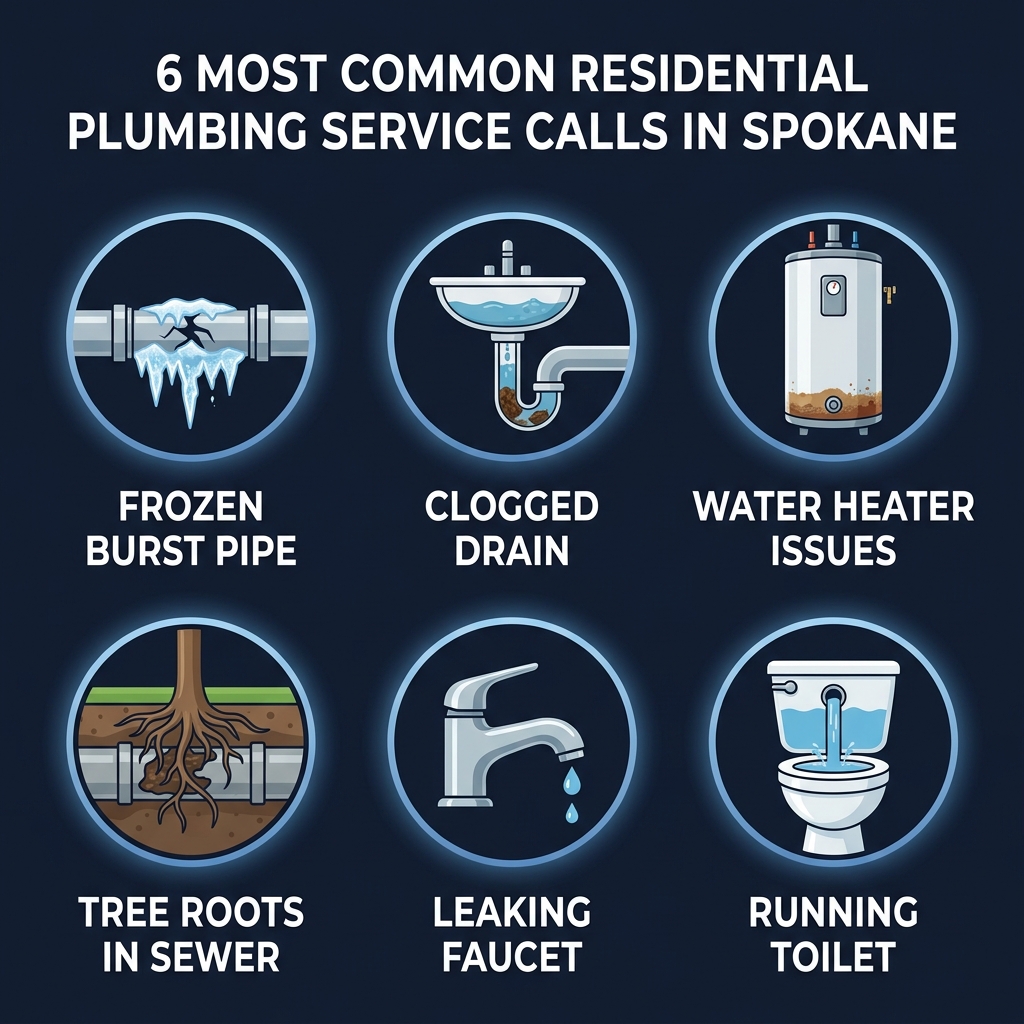
8. The 10 Most Common Spokane Service Calls
These are the plumbing issues that independent Spokane plumbers encounter most frequently, ranked by call volume. Understanding fair pricing eliminates the leverage corporate companies use to inflate quotes.
Fair Price (Spokane): $100 - $250
Red Flag Price: Above $400 for a single drain snake
Fair Price (Spokane): $200 - $500
Red Flag Price: Above $800 without camera inspection
Fair Price (Spokane): $100 - $200 (cartridge/O-ring replacement)
Red Flag Price: Above $350 or "must replace entire faucet"
Fair Price (Spokane): $75 - $200 (flapper, fill valve, or wax ring)
Red Flag Price: Above $300 or "must replace entire toilet"
Fair Price (Spokane): $1,200 - $2,200 installed
Red Flag Price: Above $3,500 for a standard 50-gal gas tank
Fair Price (Spokane): $200 - $500
Red Flag Price: Above $800 without pipe damage
Fair Price (Spokane): $300 - $800 (section repair, not full re-pipe)
Red Flag Price: "You need a full re-pipe" for a single burst
Fair Price (Spokane): $4,000 - $8,000 (2-3 bath home)
Red Flag Price: Above $12,000 without copper option
Fair Price (Spokane): $200 - $400
Red Flag Price: Above $600 or "free" (bundled into inflated repair quote)
Fair Price (Spokane): $250 - $500 installed (½ HP standard)
Red Flag Price: Above $700 for a standard unit
9. Sewer Line Materials & The Root Invasion Endemic
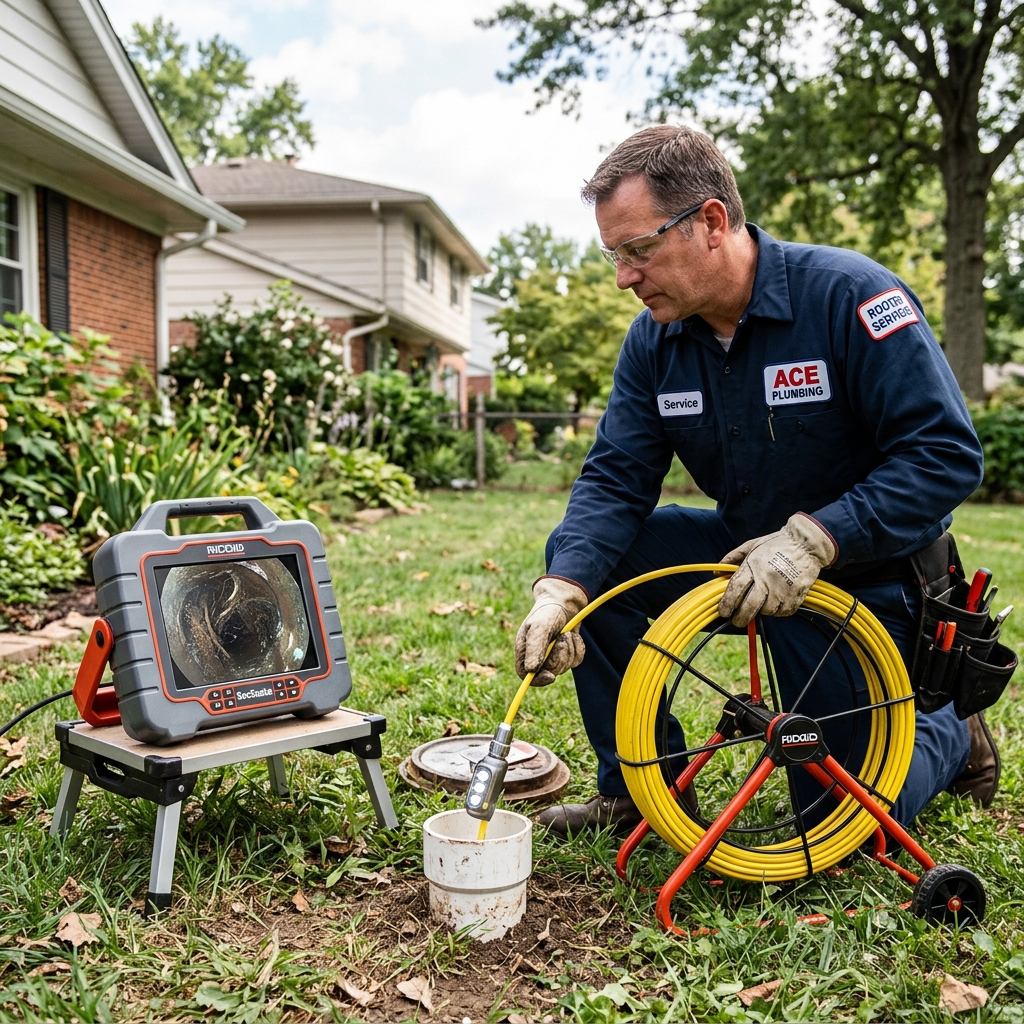
Understanding what your sewer line is made of is just as important as knowing your supply pipe material. Spokane's aging infrastructure means thousands of homes are sitting on sewer materials that are well past their engineered service life.
Era: Pre-1970s
Lifespan: 50-60 Years
Spokane Reality: Extremely common in South Hill, Browne's Addition, and Hillyard. Clay pipes are joined with mortar seams that crack with soil movement, creating entry points for tree roots. If your home has large mature trees between the house and the street, roots are almost certainly inside your clay sewer by now.
Era: 1945 – 1972
Lifespan: 30-50 Years
Spokane Reality: CRITICAL. Wood pulp and tar pressed into pipe form. Extremely common in Spokane's post-war housing boom. These pipes deform, crush, and disintegrate with age. They cannot be cleaned or repaired — only replaced. If your home was built between 1945-1972, there is a high probability your sewer is Orangeburg. A $300 camera inspection confirms it instantly.
Era: Pre-1980s
Lifespan: 50-75 Years
Spokane Reality: Durable but corrodes internally over decades. Cast iron develops channeling (grooves worn into the bottom of the pipe by constant water flow) and scale buildup that reduces effective diameter. Replacement is often done via trenchless methods.
Era: 1970s – Present
Lifespan: 75-100+ Years
Spokane Reality: Modern standard. Smooth interior resists root intrusion and buildup. Lightweight, cheap, and chemically inert. If your sewer is PVC, you're in excellent shape.
Tree Root Intrusion: Spokane's #1 Sewer Problem
Tree roots are biological hydraulic prospectors. They sense moisture vapor escaping from cracked sewer joints and drill toward it with relentless force. Once inside, the roots expand to fill the pipe, creating a dam that catches grease, paper, and debris — forming a complete blockage. Spokane's mature urban tree canopy (we love our trees) means root intrusion is the dominant sewer line problem in every neighborhood over 40 years old.
CIPP (Cured-In-Place Pipe) lining is a trenchless method that inserts a resin-saturated felt tube into the existing sewer, inflates it against the pipe walls, and cures it with heat or UV light — creating a seamless new pipe inside the old one. No digging, no destroyed landscaping, no torn-up driveways.
Cost: $4,000-$8,000 for a typical 50-80 foot residential sewer line.
Traditional Open-Trench Replacement: $6,000-$15,000+ depending on depth, length, landscaping restoration, and whether the line passes under a driveway, sidewalk, or street (which requires city permits and road cutting).
The Verdict: CIPP is almost always the better option for Spokane homes unless the existing pipe is completely collapsed or bellied (sagging). Always get a camera inspection before committing to either option — any company that quotes sewer replacement without camera verification is guessing.
10. Spokane Plumbing Code & When You Need Permits
The State of Washington adopts the Uniform Plumbing Code (UPC) with local amendments enforced by the City of Spokane and Spokane County. Understanding when permits are required — and when they're not — prevents unnecessary costs and protects your home's resale value.
Permit Required ✅
- Full or partial re-pipe (replacing supply lines throughout the house)
- Water heater replacement (yes, technically a permit is required for water heater swaps in Spokane — though enforcement varies)
- Sewer line replacement or repair
- Adding new fixtures (new bathroom, kitchen island sink, wet bar)
- Moving existing plumbing (relocating a sink or toilet during a remodel)
- Gas line work (any modification to natural gas piping)
- Backflow preventer installation (required for irrigation systems connected to potable water)
No Permit Required ❌
- Replacing a faucet, showerhead, or toilet (like-for-like fixture swaps)
- Replacing a garbage disposal
- Clearing drain clogs
- Replacing shut-off valves, supply lines, or wax rings
- Replacing a leaking section of pipe (minor repair, not relocation)
If you add a bathroom or move plumbing without a permit and inspection, the work technically doesn't legally exist. During a home sale, the buyer's inspector will flag unpermitted plumbing, the appraiser may adjust the home value downward, and the buyer's lender may refuse to fund the mortgage. Worse, if an unpermitted plumbing modification causes water damage, your homeowner's insurance company can deny the claim. Always pull permits for major work — the $75-$150 permit fee is trivial compared to the risks.
Washington State law (RCW 18.106.260) allows homeowners to perform plumbing work on their own primary residence without a plumber's license — provided they pull the correct permits and the work passes inspection. This means you can legally re-pipe your own home, install your own water heater, or add a bathroom — as long as you do it correctly and have it inspected by the city.
Important Limitation: This exemption applies only to owner-occupied primary residences. You cannot do your own plumbing on a rental property, commercial property, or a home you're building to sell. Landlords must hire licensed plumbers for all tenant-occupied properties.
11. Spokane Water Quality & Hard Water

Spokane's water quality is among the best in the nation — sourced directly from the Spokane-Rathdrum Prairie Aquifer and treated by the City of Spokane Water Department. However, "high quality" doesn't mean "problem-free" for your plumbing system.
Hardness: The Invisible Scale Builder
Spokane's water hardness typically measures between 120-180 PPM (parts per million) of dissolved calcium and magnesium — classified as "moderately hard" to "hard." While perfectly safe to drink, these dissolved minerals precipitate out of solution when heated, depositing as calcium scale inside your water heater, on showerheads, around faucet aerators, and inside dishwashers and washing machines.
PPM Range: 0 - 60 PPM
Impact on Plumbing: Minimal mineral buildup. No treatment needed.
PPM Range: 61 - 120 PPM
Impact on Plumbing: Slight scale on fixtures. Annual cleaning sufficient.
PPM Range: 121 - 180 PPM
Impact on Plumbing: Visible white scale on fixtures and showerheads. Accelerated water heater sediment. Reduced efficiency of soap and detergent.
PPM Range: 180+ PPM
Impact on Plumbing: Aggressive scale. Water softener strongly recommended. Some Spokane Valley well-water homes fall in this range.
A water softener uses ion exchange (sodium replaces calcium/magnesium) to remove hardness minerals. Cost: $1,500-$3,500 installed. Benefits include extended water heater life, reduced soap usage, softer skin/hair, and spotless dishes.
For most Spokane city water users: A water softener is a quality-of-life upgrade, not a necessity. Regular water heater flushing and periodic fixture cleaning manage moderate hardness adequately.
For Spokane Valley or well water users: If your hardness exceeds 180 PPM, a softener becomes a plumbing protection investment. Untreated very-hard water can reduce water heater lifespan by 30-50% and choke tankless units with scale within 2-3 years.
Septic System Warning: If you are on a septic system, the brine discharge from a water softener can disrupt the bacterial balance in your septic tank. Route the softener's backwash line away from the septic system if possible (dry well or separate drain).
12. The Extortion Tactics Library
Documented manipulation tactics used by corporate and Private Equity-owned plumbing franchises to extract maximum revenue from homeowners. These companies spend millions on Google Ads and TV commercials — that marketing budget comes directly from inflated service tickets.
The Pitch: "Your water heater is 8 years old. Code requires us to replace it before it bursts and floods your basement. We can do it today for $4,200."
The Truth: A standard tank water heater lasts 10-15 years. Unless the tank is visibly weeping rust or water from the absolute bottom seam (indicating internal tank failure), it does not need immediate replacement. Common issues misdiagnosed as "tank failure" include a faulty $25 thermocouple (pilot light won't stay lit), a burnt-out $40 heating element (electric units), or a corroded $20 anode rod. A legitimate plumber diagnoses the specific failure before recommending replacement.
The Pitch: "I came out to fix your leaking faucet, but I noticed your PRV isn't up to 2025 code. I legally can't leave without charging you $800 to upgrade it."
The Truth: Plumbers are NOT code enforcement officers. Unless the home is undergoing a permitted major remodel or new construction, existing plumbing is generally "grandfathered" under the code that was in effect when it was installed. They cannot legally force you to upgrade an unrelated component just to fix a leaky faucet. They can recommend upgrades — and sometimes those recommendations are legitimate — but the moment they claim they "can't leave" or "legally must" perform additional work, they are lying to extract additional revenue.
The Pitch: An ad promises a "$49 diagnostic" or "free estimate." The tech arrives, spends 5 minutes looking at the problem, then presents a quote for $2,800 with a dramatic explanation of why it's urgent. If you decline, you still owe the $49. If you agree, the $49 is "waived" — absorbed into the inflated repair cost.
The Truth: The diagnostic fee exists solely to get a commissioned salesperson inside your home. The tech's primary incentive is not to fix your problem cheaply — it's to sell the highest-ticket option available. Independent plumbers typically charge an honest trip fee ($75-$150) that covers their time regardless of whether you hire them, and provide realistic quotes based on the actual scope of work.
The Pitch: "I tested your water and found dangerous levels of [vaguely scary chemical]. You need our proprietary $5,000 whole-home filtration system to protect your family."
The Truth: Spokane's municipal water meets or exceeds all EPA Safe Drinking Water Act standards. The city publishes annual Consumer Confidence Reports detailing every tested contaminant. A plumber with a handheld TDS (Total Dissolved Solids) meter is measuring hardness minerals that are cosmetically annoying but not health hazards. If you have genuine water quality concerns, get an independent lab test ($50-$100 from a certified lab) — not a sales pitch from someone who profits from the result.
The Pitch: "We use flat-rate pricing so you know exactly what you'll pay — no surprises!" The tech opens a laminated price book and shows you a "pre-set" price of $600 to replace a kitchen faucet.
The Truth: "Flat-rate" books used by corporate franchise plumbers are designed to standardize maximum revenue extraction, not fair pricing. A faucet replacement involves $50-$150 in parts and 30-60 minutes of labor. At a fair $100-$150/hour rate, the job should cost $150-$300 total. The flat-rate book price includes embedded costs for the franchise's marketing budget, truck wraps, call center staff, manager salaries, and corporate profit margin. You're paying for their overhead, not your repair. Always ask for time-and-materials pricing as an alternative.
The Pitch: "For just $19.99/month, you get priority service, annual inspections, and 15% off all repairs!" They'll frame it as protecting your investment and saving money long-term.
The Truth: That's $240/year for a "free" annual inspection that consists of a 20-minute walkthrough designed to generate a $2,000+ repair recommendation. The 15% discount is applied to prices that were inflated 40-60% above market rate in the first place. The real purpose of these membership plans is guaranteed recurring revenue and repeat access to your home for upselling. An independent plumber will inspect your system honestly for a one-time $100-$200 service call — and they won't bill you every month for the privilege.