The Complete Northwest Landscaping Wiki
Spokane's extreme weather—from 100°F baked summers to -15°F deep freezes—demands specialized knowledge. Understand sprinkler blowouts, retaining wall drainage grids, and how corporate landscaping companies drastically overcharge for basic dirt and water mechanics.
Wiki Encyclopedia Brought To You By
1. Irrigation & Sprinkler Systems
Proper irrigation goes beyond a green lawn; it protects your home's foundation. Spokane averages limited rainfall in July and August. Over-watering creates surface runoff while under-watering leads to soil shrinkage around foundations.
| Component | Avg. Repair Cost | Failure Sign | The Truth |
|---|---|---|---|
| Valve Manifold | $300 - $600 | Zone won't shut off, constant leaking. | You rarely need a whole new manifold. The internal diaphragm is a $12 rubber part that takes 10 minutes to swap. |
| Smart Controllers | $150 - $300 | High water bills. | Rachio and Orbit B-hyve use weather-data to auto-skip rain days. They pay for themselves in one season. |
| Pop-Up Heads | $5 - $15 (DIY) | Geyser shooting into the air. | Landscapers charge $75+ per head. You can unscrew it and twist a new one on in 2 minutes. No tools required. |
| Backflow Preventer | $400 - $800 | Cracked brass, spraying water. | Always wrap the outside backflow during early fall frosts. If it freezes, the brass shatters. |
Spokane has heavy clay and rock soil that absorbs water slowly. Instead of watering a zone for 20 continuous minutes (which causes runoff), set your timer to water for 10 minutes, wait an hour, then water for 10 more minutes. The water penetrates much deeper, building drought-resistant roots.
2. The Winter Blowout Protocol
In Spokane, the frost line drops to 24 inches. If you leave water in your shallow PVC sprinkler pipes over winter, it will freeze, expand, and shatter the network across your entire yard. Correctly winterizing is non-negotiable.
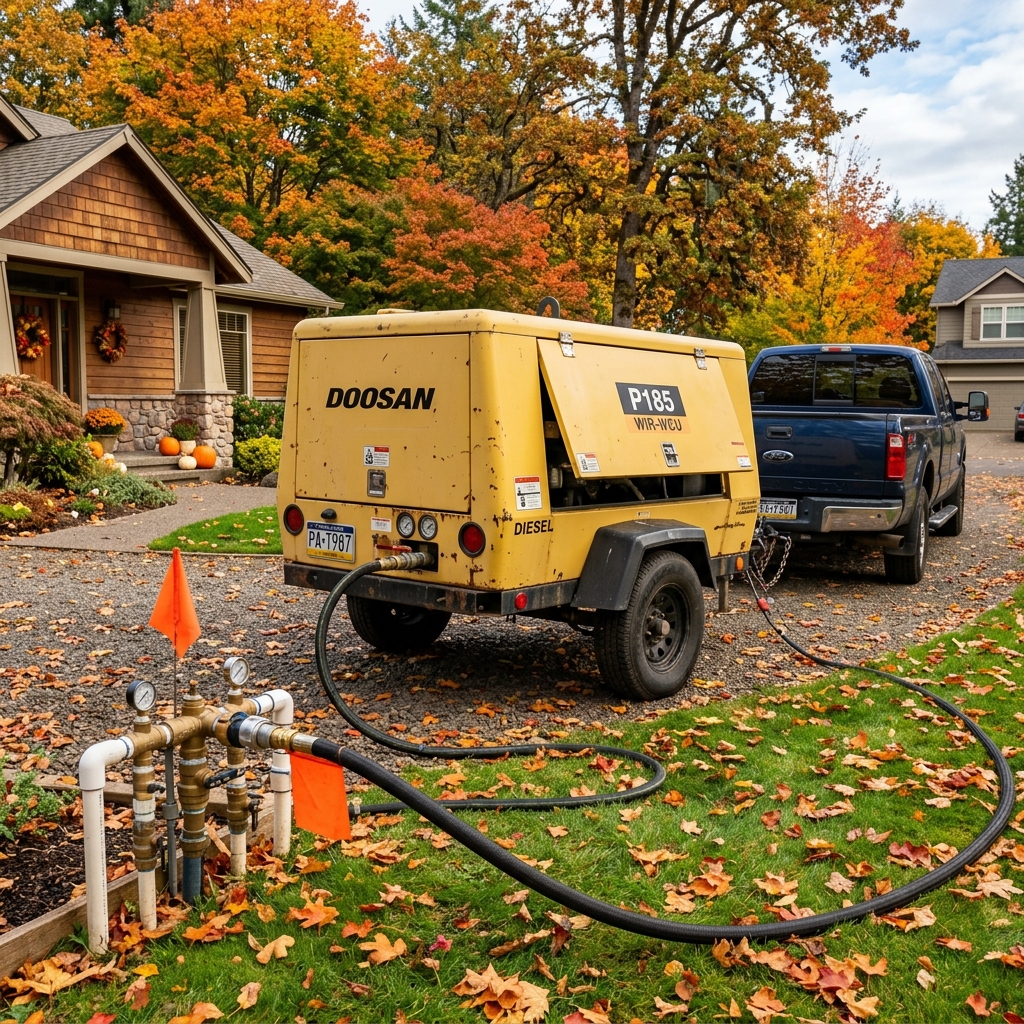
Because PVC pipes can only handle specific pressures, a sprinkler blowout requires high volume (CFM), not high pressure (PSI). A proper tow-behind diesel compressor delivers 80-130 CFM at a highly regulated 50-60 PSI. This massive volume of air effectively clears 1.5" mainlines without turning your pipes into pressurized shrapnel.
| Compressor Type | Max PSI | CFM Output | Risk Factor for 1" PVC |
|---|---|---|---|
| Pancake (Garage Use) | 150 PSI | 2 - 4 CFM | Extreme Danger (Shatter Risk) |
| Contractor Wheelbarrow | 135 PSI | 5 - 8 CFM | High Risk (Incomplete Blowout) |
| Tow-Behind Diesel (185 CFM) | Regulated at 50 PSI | 185 CFM | Safe & Effective |
Homeowners often attempt to use a 6-gallon garage air compressor. These output high PSI but very low CFM. They will push air right past the water, leaving heavy water pooling in the low spots of your pipes where they will promptly freeze and crack. Hire a professional with a towable compressor before November 1st.
3. Retaining Walls & Hardscaping Anatomy
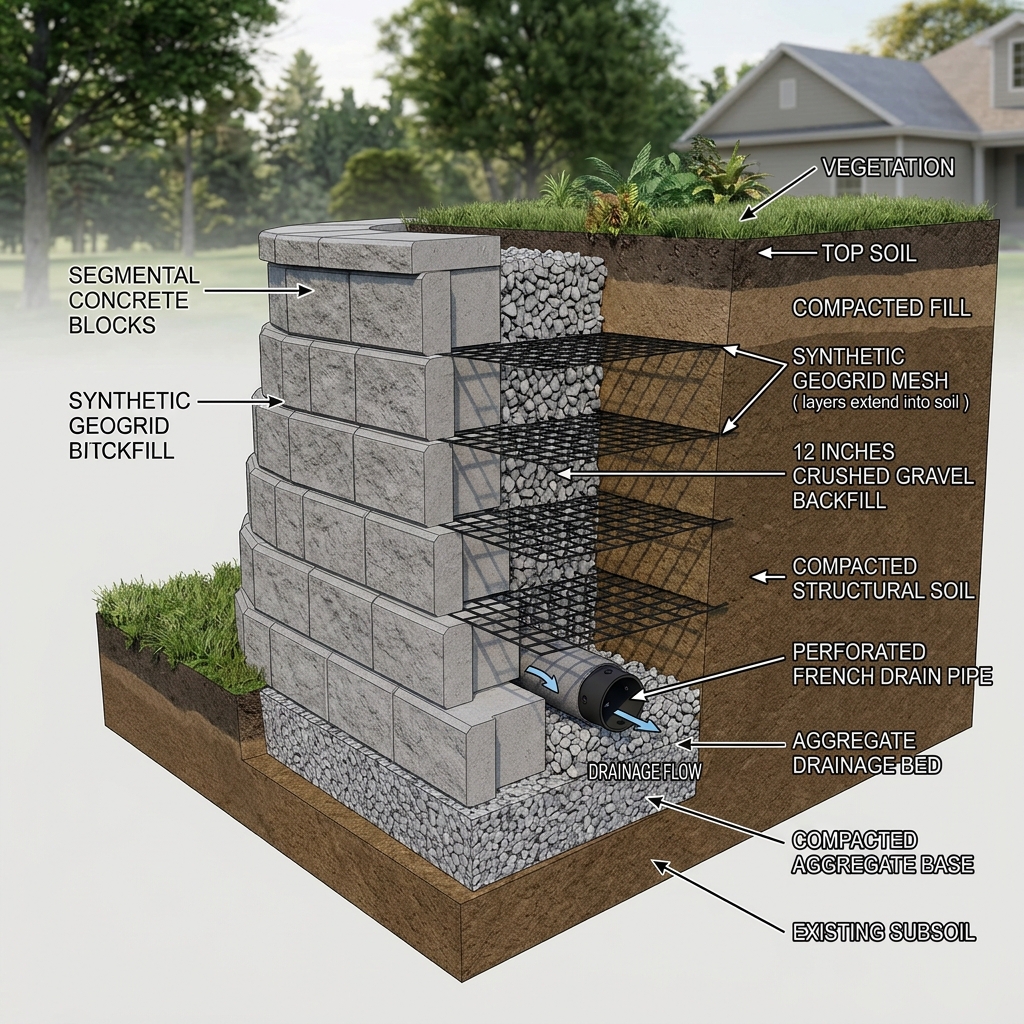
Proper hardscaping isn't just about moving blocks; it's about water management and resisting gravity over decades. Spokane's basalt bedrock and rolling topography means poorly built walls will slump within three years due to frost-heave and hydrostatic pressure.
Segmental Block Walls
Mechanics: Concrete blocks with an interlocking lip. They rely on their sheer massive weight ("gravity wall") to hold back the earth.
The Secret Trick: A retaining wall doesn't fail because dirt is heavy. It fails because wet dirt is heavy. True experts install a french drain directly behind the base course and backfill the first 12-18 inches entirely with clean 5/8-minus crushed gravel.
| Failure Mode | Technical Cause |
|---|---|
| Overturning | Hydrostatic pressure from trapped water pushing the top blocks forward. |
| Sliding | Lack of buried base course; lateral earth pressure overcomes friction. |
Natural Basalt Boulder Walls
Mechanics: Local heavy boulders stacked carefully. Offers a beautiful Pacific Northwest rustic aesthetic and naturally allows water drainage through the cracks.
The Secret Trick: Large boulders (1-2 tons) can settle massively. The base course must be buried at least a third into the native compacted earth to prevent rolling.
For any segmental block wall over three feet high, contractors must use geogrid—a tough synthetic mesh sandwiched between the blocks and extended back into the dirt to tie the wall and soil together into a unified mass. If your quote doesn't explicitly mention geogrid and weeping drain tile, throw it in the trash.
4. Hydroseeding vs. Sod & Root Architecture
Establishing new grass requires understanding root geometry. Both methods are effective, but the contractor's process matters much more than the material. In Spokane's drought-prone summers, shallow roots will literally roast within 48 hours of a missed watering.
| Method | Cost per Sq Ft | Time to Usability | The True Trade-off |
|---|---|---|---|
| Sod (Rolled Turf) | $1.50 - $2.50+ | Instant look, ready in 3 weeks | You get instant gratification, but the roots are sliced horizontally at the farm. They sit lazily on the surface and require massive amounts of water to survive the transplant shock. |
| Hydroseeding | $0.15 - $0.35 | 4-6 weeks | Cheaper but requires patience. The seed mix (mulch, fertilizer, seed) sprouts naturally in place. The roots drive straight down deep into the soil matrix, creating a fundamentally stronger, more drought-resistant lawn. |
5. Spokane Soil Science
Much of Spokane sits on top of ancient glacial flood plains layered with heavy clay, sand, and sharp basalt cobble. If you have large ponderosa pines on your property, the massive drop of pine needles increases the soil acidity (lowers the pH) heavily.
Core Aeration: Pulling physical plugs of dirt out of your lawn. This is highly recommended in Spokane's clay-heavy soils. It relieves compaction and allows oxygen, water, and fertilizer down to the root zone.
Dethatching (Power Raking): A violent process of ripping dead grass off the surface. Usually only needed if the thatch layer exceeds 1/2 inch. Wait until late spring; doing this too early damages the delicate new grass crowns.
6. Geomorphology & Landscape Ecology
Scientific landscape ecology studies the relationship between ecological processes in the environment and specific ecosystems. In Spokane, your residential yard isn't just grass; it is a micro-ecosystem reacting to the region's grand geomorphology (the physical evolution of topographic features).
Topography in Spokane was sculpted by ancient glacial floods, creating areas of deep aggregate rock, sudden cliffs, and localized wetlands. Properly managed yards use Integrated Landscape Management—where small residential choices (like planting drought-tolerant fescue instead of thirsty Kentucky Bluegrass) directly reduce strain on the Spokane Valley-Rathdrum Prairie Aquifer. True landscaping isn't just decorating; it's managing the geologic and hydrologic surface processes at a micro scale.
7. Cultural Design History
The term "landscape" emerged from the Old English landscipe (meaning to shape a system of human-made spaces) and the Dutch landschap (referring to scenic paintings). Modern landscaping is the deliberate modification of visible land features—blending artificial elements with natural flora for emotional and aesthetic appeal.
Before 1800, landscape design was reserved for royal estates and palaces (like Versailles). The term Landscape Architecture was popularized in the late 19th century by Frederick Law Olmsted, exactly around the time he was designing Central Park. Early designs favored the "English landscape garden" aesthetic, which deliberately arranged nature to look wild yet idyllic. Today, professional Spokane landscapers bring these exact principles to suburban properties—using multi-disciplinary knowledge of botany, soil science, and environmental psychology to shape the "cultural landscape" of the Northwest.
8. Spokane Service Categories Deep-Dive
When hiring top-tier local landscape professionals (like Spokane's established Haase Landscape), projects are broken down into profound, specialized disciplines. Knowing these disciplines ensures you don't hire a simple lawn-mowing crew to build a master-planned outdoor kitchen.
Outdoor Living & Master Kitchens
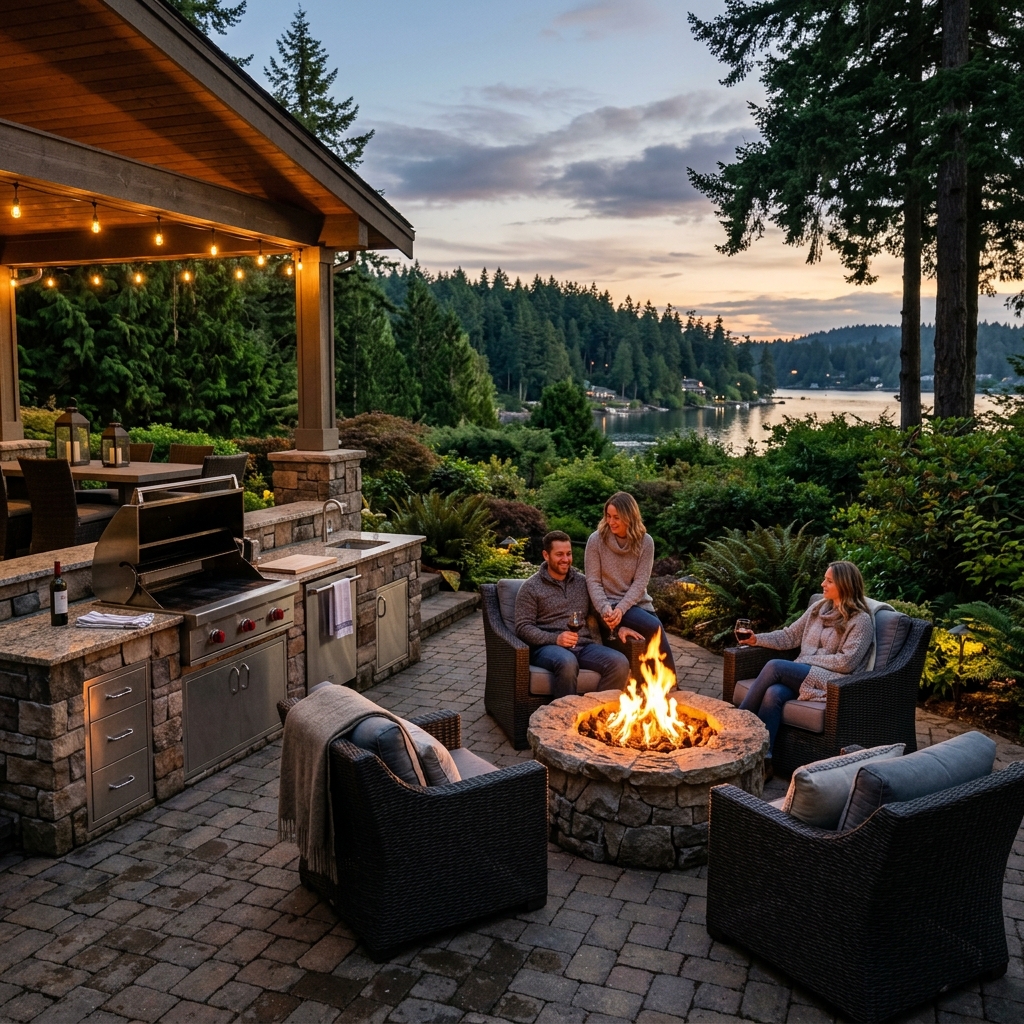
True outdoor living spaces extend the square footage of your home. Premium installations feature Belgard modular kitchens, high-Btu stainless steel built-in grills, and custom stone fire pit kits. Because Spokane experiences massive temperature swings, these masonry units must be assembled with flexible, heat-resistant adhesives to prevent thermal cracking during the -10°F winter freezes.
Permeable Pavers & Porcelain Slabs
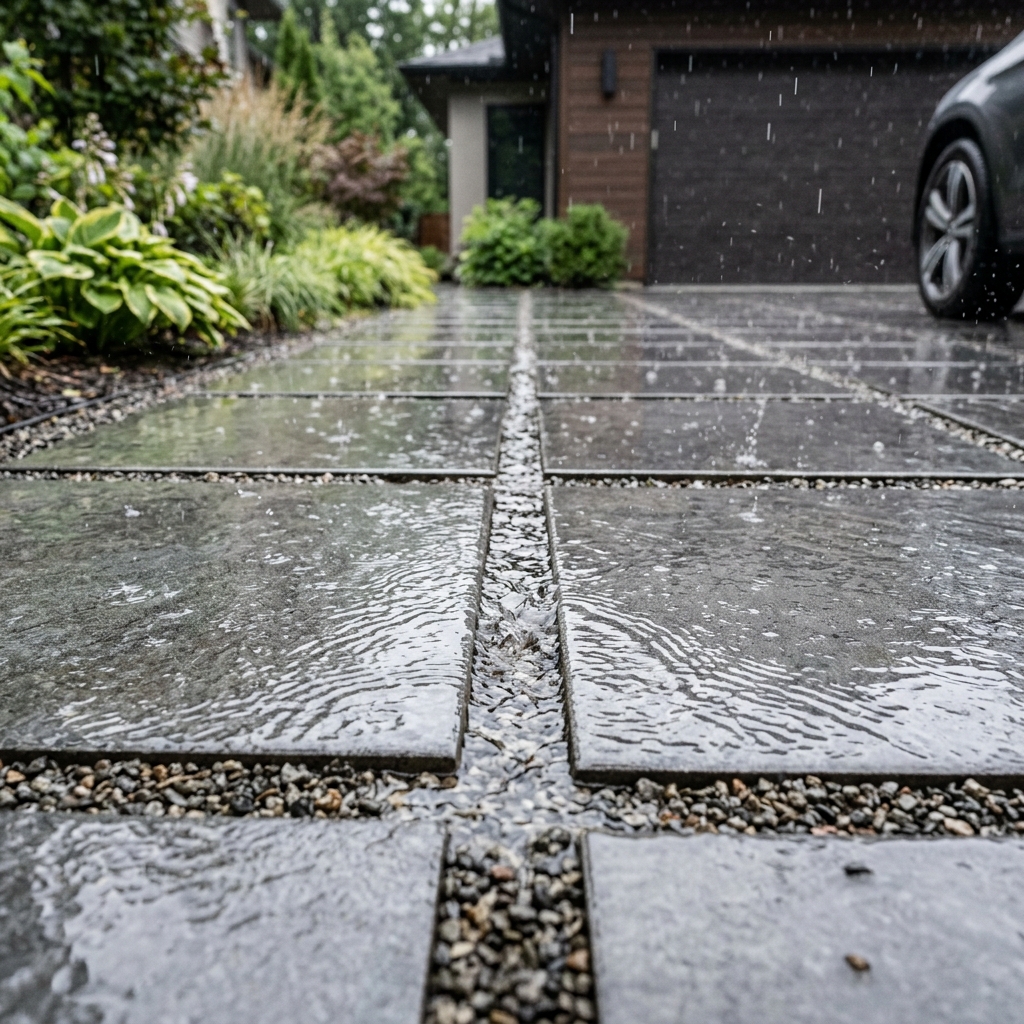
Concrete driveways eventually crack in Spokane due to frost heave. The modern, extremely durable alternative is the Permeable Paver System.
- Hydrologic Function: Rainwater instantly drains through the precisely engineered gaps filled with clean crushed gravel, returning directly to the aquifer and eliminating driveway puddles.
- Porcelain Upgrades: Ultra-dense porcelain slabs are becoming the ultimate luxury surface—they are completely stain-resistant, never require chemical sealing, and laugh off magnesium chloride de-icers.
Commercial Snow & Ice Management
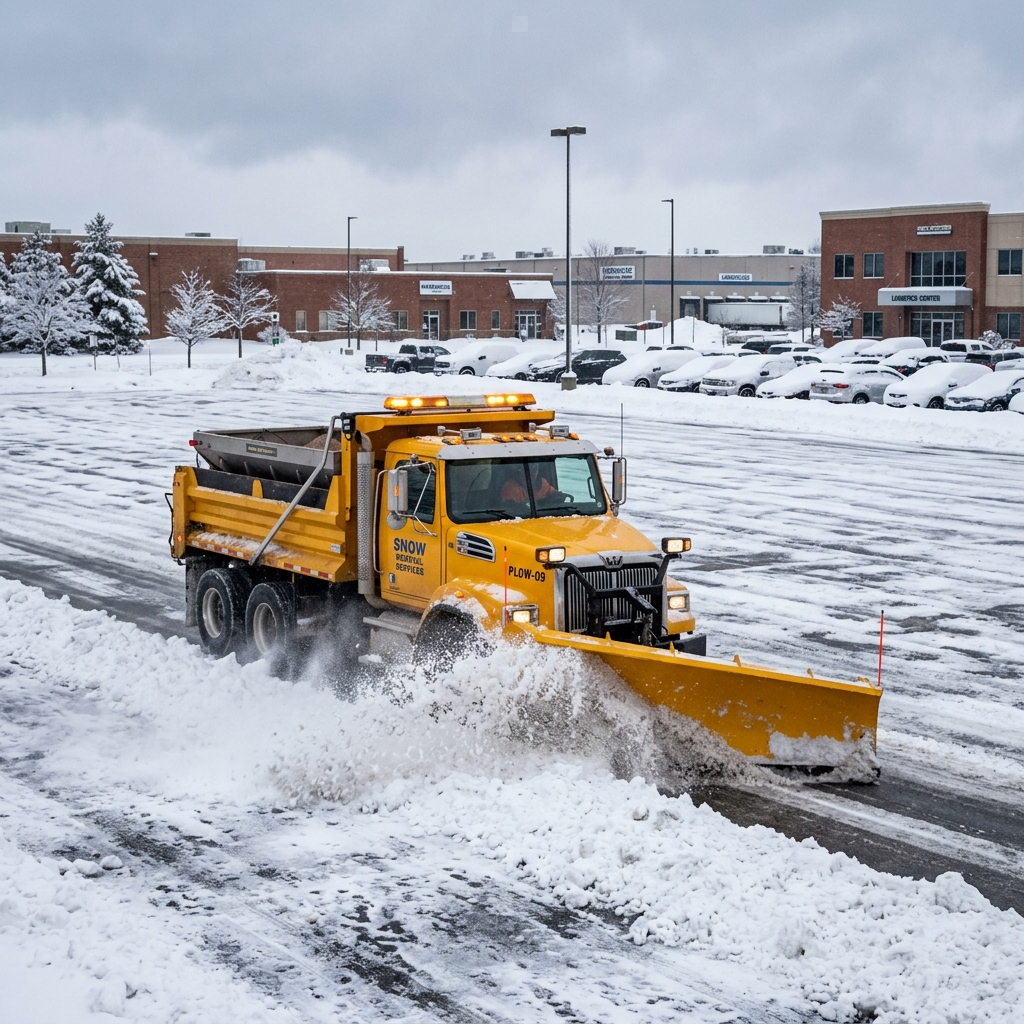
When the winter hits, elite landscaping operations pivot entirely to commercial snow removal. This isn't a guy with a shovel; this is an intricate logistical war involving heavy machinery, strict contract routing, and liability mitigation.
| The Logistics | The Reality |
|---|---|
| Zero-Tolerance Contracts | Hospital and HOA parking lots must be cleared any time accumulation hits 1 inch, requiring 24/7 dispatched fleets. |
| Liquid De-Icing | Applying liquid brine to asphalt *before* a storm hits prevents the snow from bonding mechanically to the surface, making plowing massively more efficient. |
9. The Extortion Tactics Library
The barrier to entry in landscaping is low. Anyone with a truck and a shovel can claim to be a contractor. Here is how fly-by-night operations exploit homeowners.
The Pitch: They quote a ridiculously low price for a new lawn installation.
The Truth: To save money, they truck in extremely low-grade "fill dirt" instead of high-quality screened topsoil. Worse, they spread it only 1-2 inches thick over raw clay. The sod takes root immediately, looks great for 6 weeks, and then effectively dies because the roots hit the clay hardpan and cannot penetrate. Always mandate a minimum of 4 inches of rich 3-way topsoil mix.
The Pitch: A flyer on your door offers a "$39 blowout special."
The Truth: Legitimate landscaping companies charge $75-$100+ because they carry high liability insurance and use $15,000 tow-behind compressors. The $39 guy shows up in an unmarked van, hooks up an unregulated 120 PSI air compressor, and literally shrapnels your internal sprinkler valves or cracks PVC pipes under the ground. He takes your cash and you discover the $2,000 destruction the following spring when nothing works.
The Pitch: They build a beautiful fire pit and paver patio for 40% less than respected local companies.
The Truth: A paver patio is 90% foundation and 10% pavers. They skipped excavating deeply and simply spread a thin layer of sand over dirt, rather than compacting 4-6 inches of crushed gravel base (5/8-minus) and 1 inch of bedding sand. After one wet Spokane winter, the frost heave acts like mini-earthquakes. By spring, your patio is an uneven, wavy safety hazard.
The Pitch: They provide a remarkably low written quote for excavating a retaining wall or trenching an irrigation line.
The Truth: Hidden deep in the fine print is an "extra charge per hour if we hit rock." Because Spokane is literally built on ancient basalt floodplains, they know they will hit rock. A $2,000 estimate suddenly turns into a $6,000 hostage situation midway through the job.
The Pitch: A seemingly professional crew promises a "10-Year Ironclad Warranty" on their new sprinkler installation.
The Truth: They operate under a burner LLC. In two years, when the poorly glued PVC joints burst beneath your lawn, you'll discover the LLC has been dissolved. You cannot collect on a warranty from a company that legally no longer exists. Always check the active longevity of their business license.
The Pitch: A contractor offers to install roll-out sod for highly discounted square footage pricing.
The Truth: To maximize their margin, they stretch the sod rolls as tightly as possible rather than cleanly butting the seams together. Within two weeks, as the sod inevitably shrinks during natural rooting, giant dead dirt gaps appear between every single roll of grass in your yard.
The Pitch: They install a brand new irrigation system but quote you for fewer total zones than their competitors.
The Truth: To save $50 on parts, they tie entirely different yard profiles (e.g., shady lawn and a sunny garden bed) into the exact same valve. As a result, you either massively over-water your garden or under-water your lawn. Water pressure also drops drastically, causing sprinkler heads to barely pop up.
The Pitch: A random crew driving through your neighborhood knocks on your door and offers to trim a low-hanging branch for $50.
The Truth: Once they get into the canopy, they suddenly claim the tree is "diseased" and proceed to wildly over-prune or "top" a healthy Ponderosa pine. Topping a mature tree destroying its central leader inevitably introduces rot and kills the tree, ultimately costing you $2,000+ to have it professionally removed.
The Pitch: A landscaper guarantees zero weeds by installing "premium barrier" under your new rock features.
The Truth: Professional barrier is thick, permeable geotextile fabric. Scammers roll out cheap, solid black plastic tarp. It completely suffocates the soil below, preventing water and oxygen from reaching tree roots. Weeds simply blow onto the surface dust anyway, and the plastic shreds into horrible black strips poking out of your rocks within a year.
The Pitch: You are offered a hydroseeding service for literally pennies on the dollar compared to other contractors.
The Truth: Real hydroseed is a thick, nutrient-dense slurry of wood fiber mulch, fertilizer, and premium seed. The scammer's tank is filled with 95% water and green dye. They spray your dirt green, it looks great for 24 hours until the dye fades, and absolutely no grass ever germinates.
The Pitch: Extremely high-speed, cheap core aeration offered via door-hangers in the middle of summer.
The Truth: A proper core aeration requires the lawn to be deeply soaked the day prior. Without soaking, the heavy aerator simply bounces off Spokane's hard-baked summer clay. The contractor will drive the machine over your entire lawn, pull absolutely zero dirt plugs, take your $75, and leave you with zero agronomic benefit.
The Pitch: Sales reps forcefully push you into a rigid, expensive 6-step chemical fertilizer subscription without ever testing your soil.
The Truth: In Spokane, pine needle drop often drastically lowers soil pH. If your soil is too acidic, grass cannot mechanically absorb nitrogen fertilizer no matter how much you dump on it. The soil needs basic, cheap lime first. You are paying thousands of dollars for nitrogen that simply washes away into the aquifer without feeding your grass.
The Pitch: The lawn mowing boy offers to "spray the weeds in your rock beds for an extra 20 bucks."
The Truth: To legally apply general use herbicides commercially in Washington state, operators must possess a valid WSDA applicator's license and carry specific environmental insurance. Unlicensed operators often mix agricultural-grade chemicals at highly toxic, incorrect ratios. This poses an immediate, serious poison hazard to your children, dogs, and local watershed.