The Complete Residential Roofing Encyclopedia
This is the most comprehensive residential roofing guide published on the internet. Built from the International Residential Code (IRC), manufacturer installation specifications, Washington State contractor licensing requirements, and the raw field experience of independent Spokane roofers. Whether you are staring at a $22,000 re-roof estimate after a hailstorm or wondering why your ceiling is leaking in January—this encyclopedic deep-dive gives you every technical detail you need to make an informed decision and never get taken advantage of by storm-chasing corporate crews.
1. The Roof System: More Than Shingles
A residential roof is not a single product. It is a multi-layered engineered system consisting of 7 to 9 independent components that work together. When a corporate roofer says “you need a new roof,” they often mean they want to replace 1 or 2 layers while charging you for all 9. To protect yourself, you need to understand every single layer.
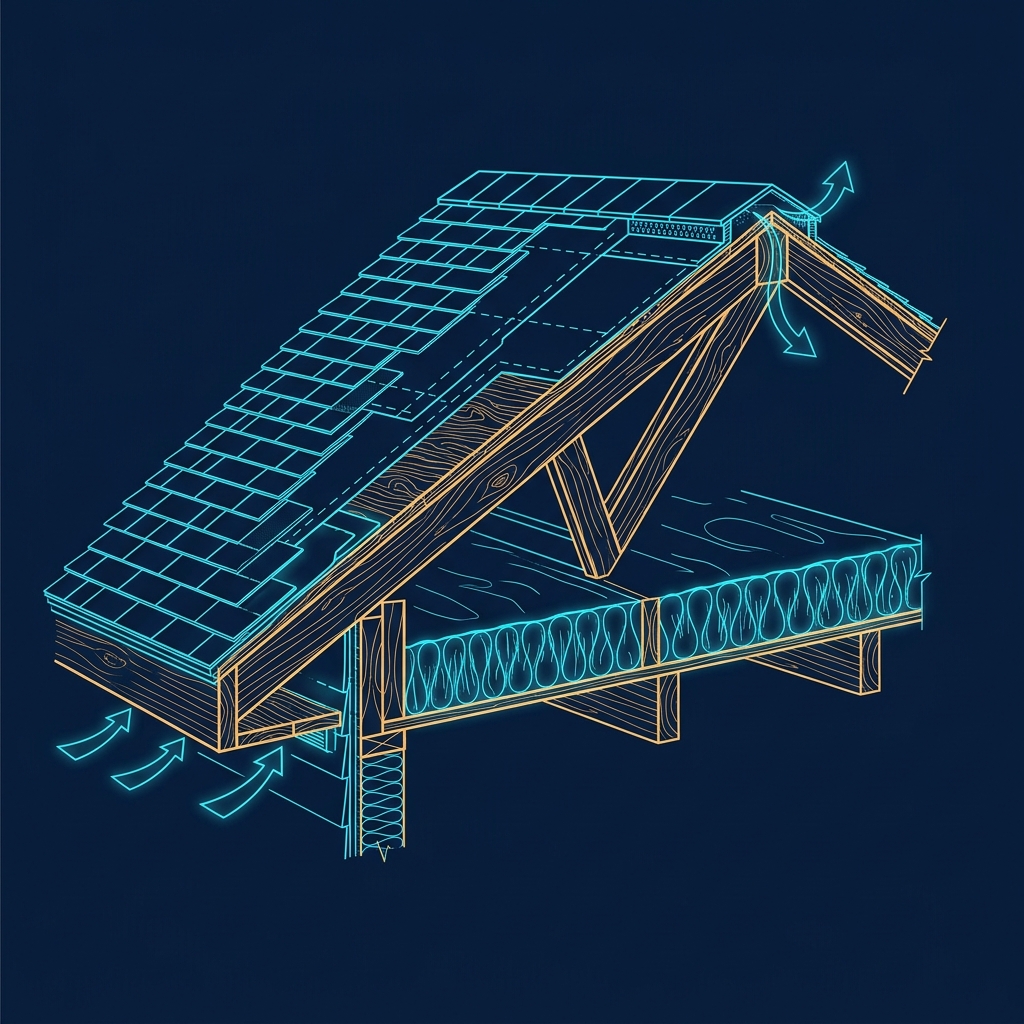
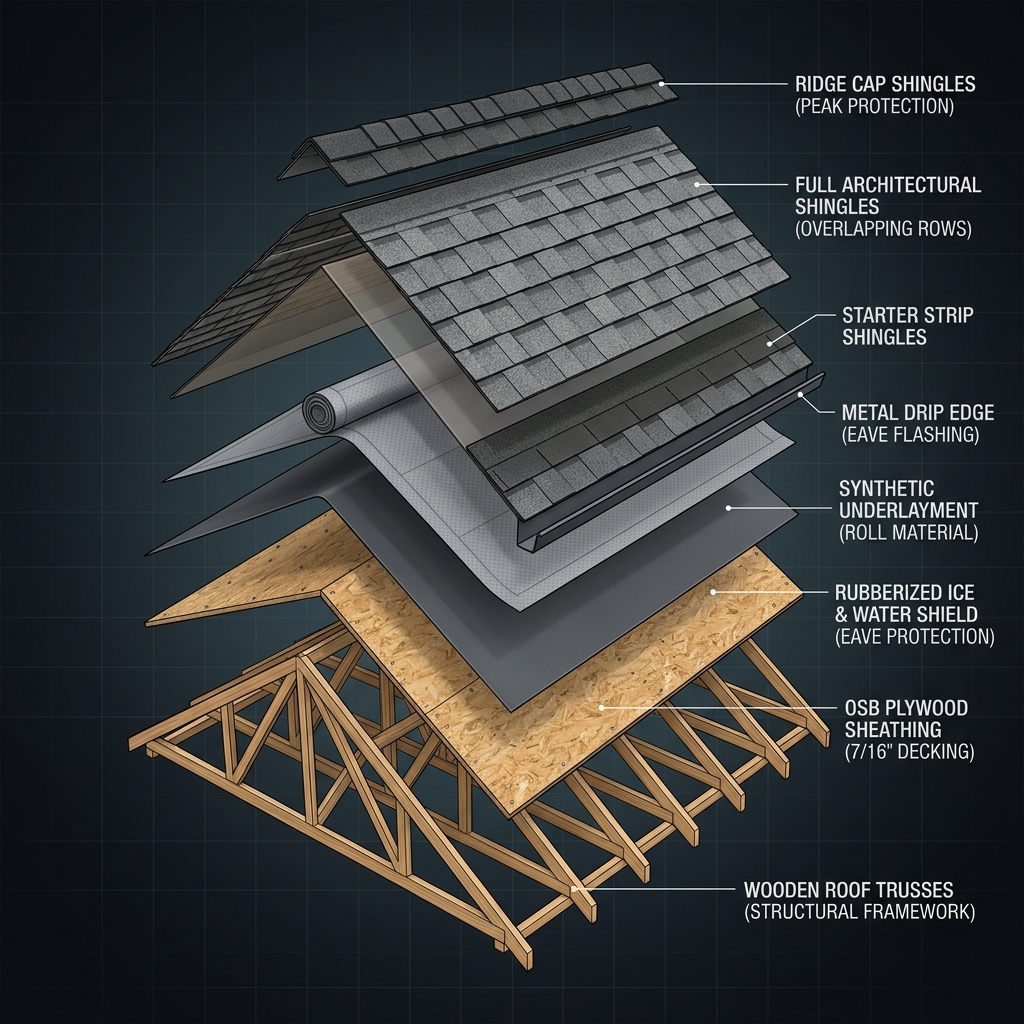
From the bottom up, here is the complete stack:
- Roof Trusses or Rafters: The structural skeleton. Engineered wood trusses (modern) or dimensional lumber rafters (pre-1970).
- Roof Deck (Sheathing): 7/16″ or 1/2″ OSB or plywood panels nailed to the trusses. This is the flat surface everything else sits on.
- Ice & Water Shield: Self-adhering rubberized membrane applied at vulnerable areas (eaves, valleys, around penetrations).
- Underlayment: Synthetic felt (or traditional #30 tar paper) covering the entire deck as a secondary water barrier.
- Drip Edge: Metal L-shaped flashing along all edges preventing water from wicking under the shingles.
- Starter Strips: A purpose-built adhesive strip along the eaves that seals the first course of shingles against wind uplift.
- Shingles (or Metal Panels): The visible, outermost weathering surface.
- Ridge Cap: Specially formed shingles covering the peak where two slopes meet.
- Ridge Vent: A narrow, screened exhaust slot running the entire peak allowing hot attic air to escape.
2. Layer-By-Layer Anatomy
A. The Roof Deck (Sheathing)
The deck is the flat platform to which everything is fastened. In Spokane homes built before 1970, you will often find 1×6 skip sheathing—individual boards with gaps between them, originally designed for cedar shake roofs. Modern reroofs over skip sheathing require a full overlay of 7/16″ OSB or 1/2″ CDX plywood to provide a continuous nailing surface for asphalt shingles.
The Hidden Rot Problem: When a leak goes undetected for months, the OSB absorbs water and swells into a spongy, delaminated mass. A competent roofer will walk the deck checking for soft spots before installing new shingles. Rotten deck must be cut out and replaced in sections. Expect to pay $75–$125 per sheet of replacement OSB, installed.
B. Ice & Water Shield
This is a self-adhering, rubberized asphalt membrane (brands: Grace Ice & Water Shield, GAF WeatherWatch). It physically fuses to the deck, creating an impenetrable seal even if a roofing nail is driven through it. Washington State code (IRC R905.1) requires it along eaves for a minimum of 24 inches past the interior wall line. In Spokane’s climate zone, best practice is extending it 36 inches up from the eave edge. It is also mandatory in all roof valleys where two slopes converge and water concentration is extreme.
C. Synthetic Underlayment
Covers the entire remaining deck surface as the secondary water barrier. Modern synthetic underlayment (brands: GAF FeltBuster, CertainTeed DiamondDeck) is dramatically superior to traditional #15 or #30 tar paper—it does not absorb water, does not wrinkle, and is UV-resistant for up to 6 months of exposure during construction delays. A crew that is still using organic felt paper in 2024 is cutting costs at your expense.
D. Drip Edge & Starter Strip
Drip Edge: A bent metal flashing installed along the rakes (sides) and eaves (bottom edges). It prevents water from curling under the shingle edge and wicking into the fascia board, which is the #1 cause of fascia rot. IRC code requires drip edge on all new roofs. If your roofer skips drip edge, they are violating building code.
Starter Strip: A pre-made adhesive shingle strip pre-cut in the factory. When installed at the eave edge, its adhesive strip bonds to the bottom of the first visible course of shingles, creating a wind-resistant seal that prevents blow-offs during Spokane’s frequent 40–60 mph windstorms. Without it, the first row of shingles has nothing to grip.
3. Roofing Materials: The Complete Breakdown
There are four material categories commonly installed in the Spokane region. Understanding their true lifespans, cost-per-square, and failure modes will prevent you from overpaying or accepting an inferior product.
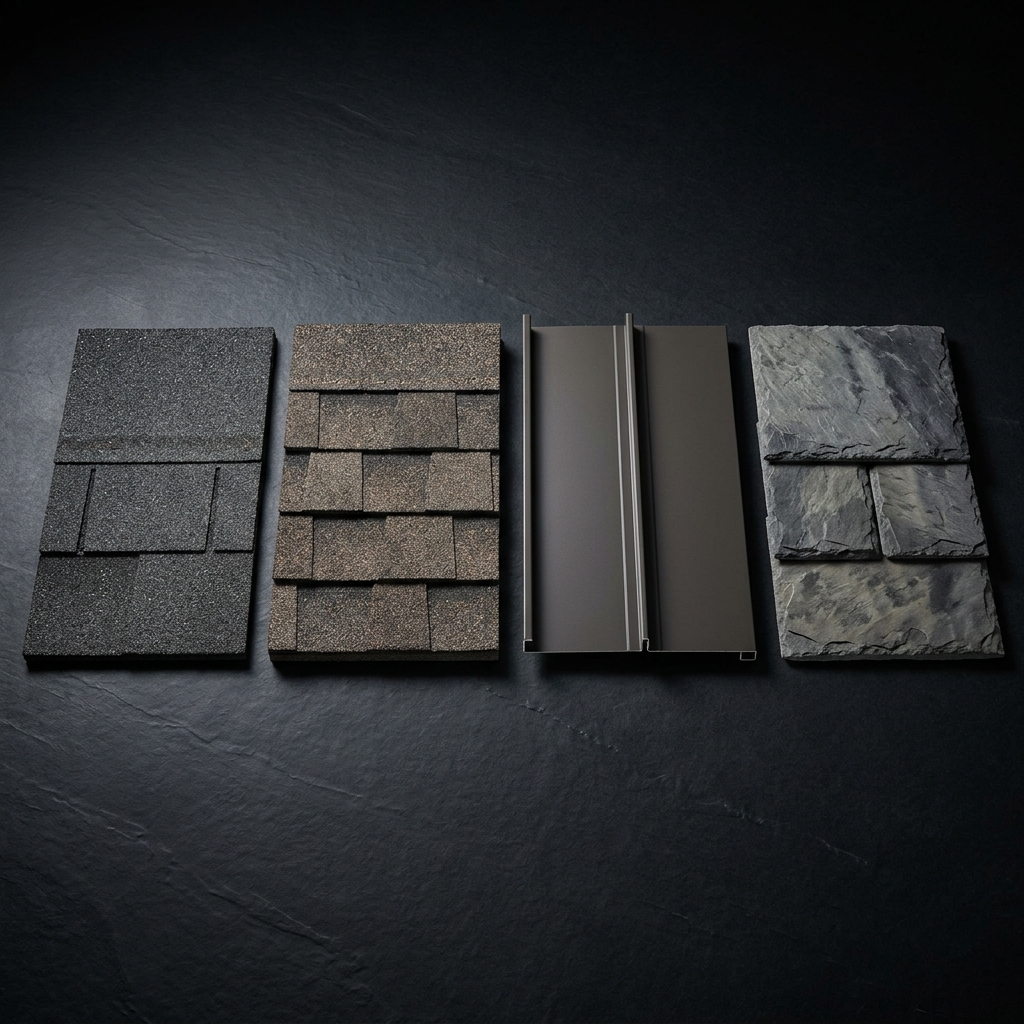
| Material | Lifespan | Cost / Square | Wind Rating | Hail Rating |
|---|---|---|---|---|
| 3-Tab Asphalt | 15–20 years | $90–$120 | 60 MPH | Class 1 |
| Architectural (Dimensional) | 25–30 years | $120–$180 | 110–130 MPH | Class 3–4 |
| Standing Seam Metal | 40–70 years | $350–$700 | 140+ MPH | Class 4 |
| Composite Slate/Shake | 50+ years | $400–$800 | 110+ MPH | Class 4 |
* A “square” = 100 square feet of roof surface. A typical Spokane ranch-style home has 18–25 squares. Prices shown are material only.
3-Tab Asphalt: DO NOT ACCEPT THIS
3-tab shingles are the cheapest, thinnest, flattest asphalt shingle ever manufactured. They have a single layer of fiberglass mat and virtually no dimensional profile. Their wind rating tops out at 60 MPH—well below Spokane’s frequent winter windstorms. No legitimate roofing contractor should be installing 3-tab shingles on a full re-roof in 2024. If a company quotes you 3-tab shingles, they are either cutting costs to maximize their margin, or they sourced discontinued stock.
Architectural (Dimensional) Shingles: The Standard
Architectural shingles (GAF Timberline HDZ, Owens Corning Duration, CertainTeed Landmark) are the modern standard for residential roofing. They use two laminated layers of fiberglass mat bonded together with asphalt adhesive, creating a thick, textured, dimensional profile. They carry lifetime limited warranties (read: 25–30 years of realistic performance) and are rated up to 130 MPH wind resistance—which is critical for Spokane County where straight-line wind events routinely hit 50–70 MPH every winter.
Standing Seam Metal: The 50-Year Roof
Standing seam metal roofing uses interlocking vertical panels with raised, concealed-fastener seams. Because the fasteners are hidden beneath the seam, they never penetrate the surface and never create a leak point. Metal reflects 70%+ of solar radiation, and snow slides off cleanly (critical if you have solar panels). The upfront cost is 2.5–3x asphalt, but metal roofs in the Pacific Northwest commonly last 50–70 years with zero maintenance, making it the lowest total cost of ownership over the life of the structure.
4. Attic Ventilation: The Silent Killer
Ventilation is the single most misunderstood and most critical component of a roofing system. Inadequate ventilation is the root cause of three catastrophic and extremely expensive failures: premature shingle failure, ice damming, and mold growth.
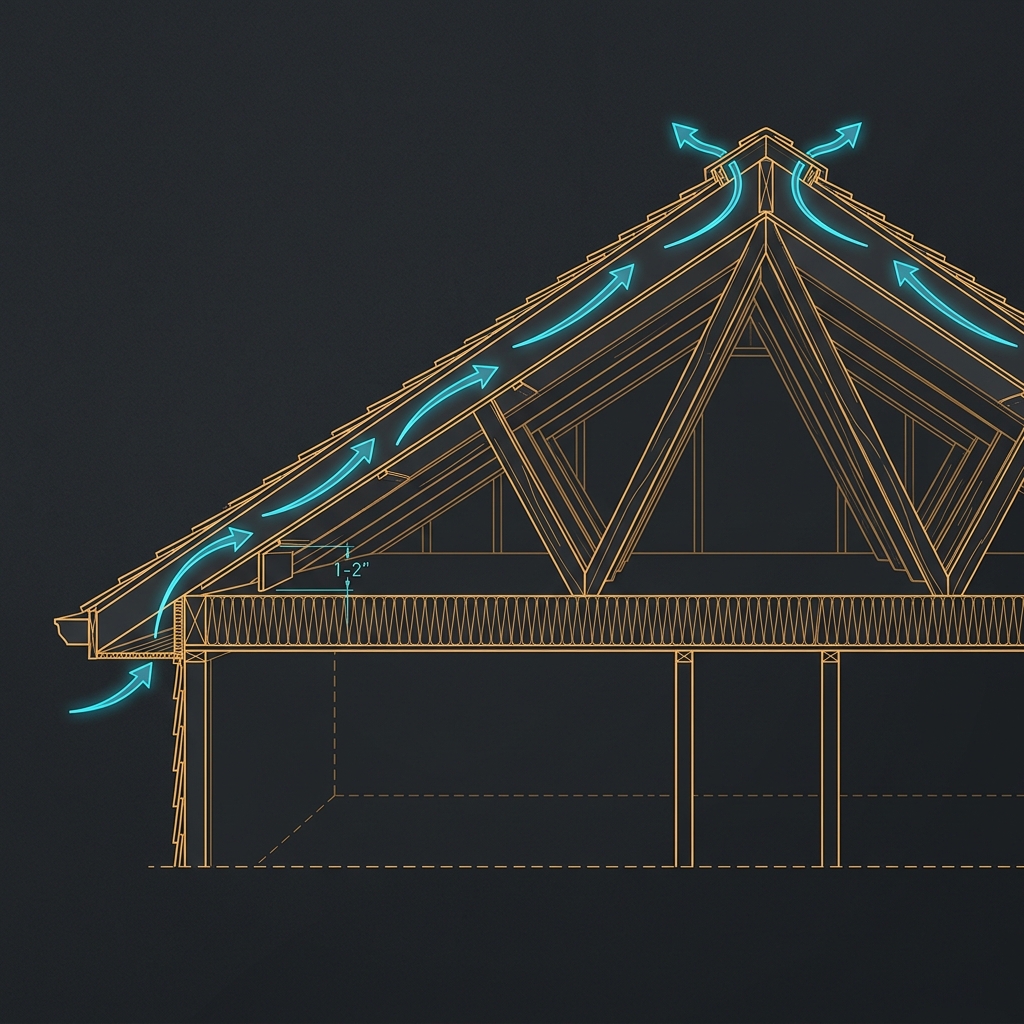
How Ventilation Works
A properly ventilated attic operates on a simple convection loop:
- Intake (Soffit Vents): Cool, dry outside air enters through continuous or individual vents in the soffit (the horizontal underside of the eave overhang).
- Channeling (Rafter Baffles): Polystyrene baffles stapled between the rafters prevent blown-in insulation from blocking the airflow path from soffit to ridge.
- Exhaust (Ridge Vent): As hot air naturally rises, it exits through the ridge vent at the peak. This creates continuous negative pressure that pulls more cool air in from the soffits.
The 1:150 Rule (IRC R806)
The International Residential Code requires a minimum of 1 square foot of Net Free Area (NFA) ventilation for every 150 square feet of attic floor space. When a balanced system is used (50% intake, 50% exhaust), this ratio can be relaxed to 1:300. A typical 1,500 sq ft Spokane ranch home needs at minimum 10 sq ft of total ventilation opening. Critically, the system must be balanced: more exhaust than intake creates negative pressure that can suck driven rain and snow into the attic through the ridge vent.
What Happens With Bad Ventilation
- Summer: Trapped attic heat exceeds 160°F. Shingle manufacturers explicitly void their warranty if ventilation is inadequate because the extreme heat bakes the asphalt and causes premature granule loss, curling, and cracking.
- Winter: Warm, moist air from your living space rises into the attic. Without ventilation to flush it out, the moisture condenses on the cold underside of the roof deck, saturating the OSB and breeding massive black mold colonies. By the time you see the ceiling stains, the damage is already catastrophic.
5. Ice Dams: Spokane’s #1 Roof Destroyer
Every single January and February, Spokane roofing contractors are flooded with emergency calls from homeowners with water pouring through their ceilings. The culprit is almost always the same: ice damming.
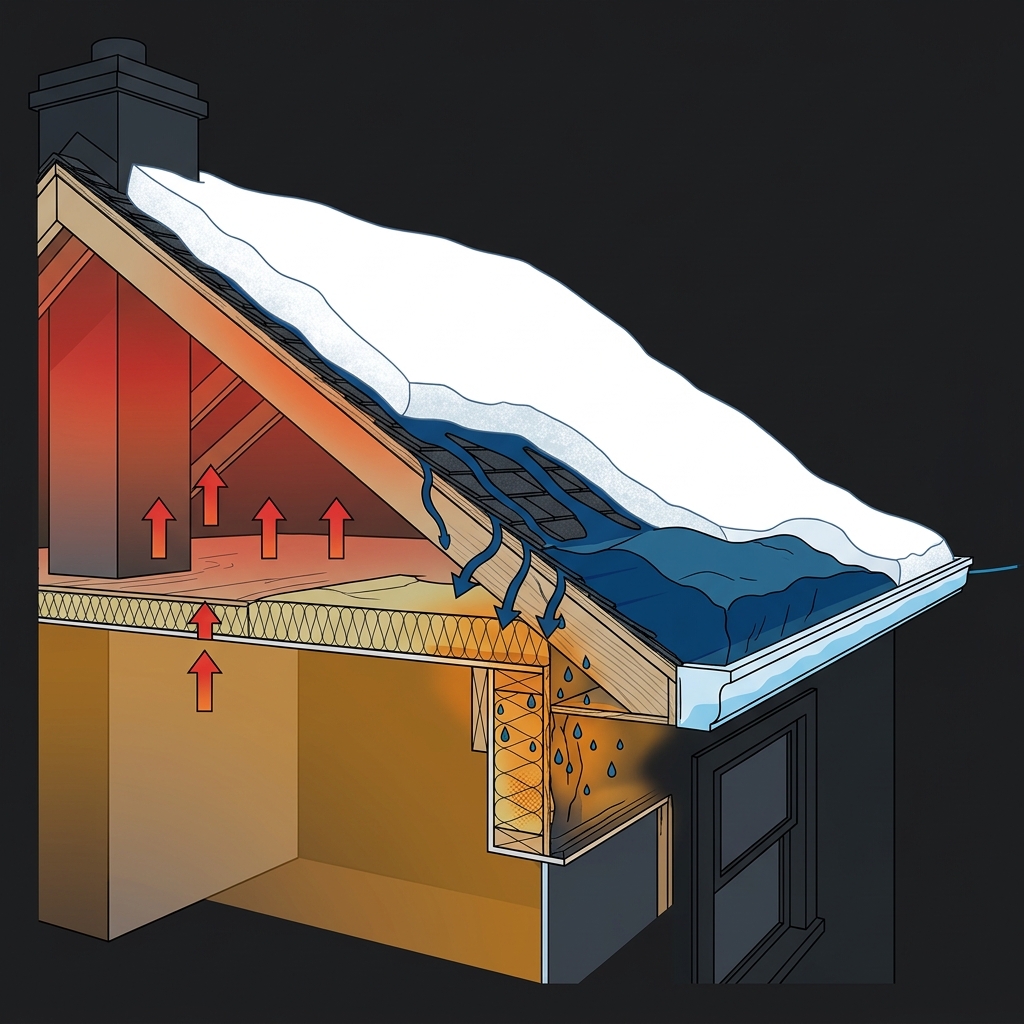
How Ice Dams Form
- Heat Loss: Warm air escapes your living space through inadequate attic insulation (especially around recessed lights, attic hatches, and bathroom exhaust fans vented into the attic instead of outdoors).
- Snow Melt: The escaped heat warms the upper roof deck, melting the snow from underneath. Liquid water runs down under the snowpack toward the eaves.
- Refreezing: The eave overhang extends past the insulated wall below. It is ice cold. The running water hits this freezing zone and refreezes into a massive ridge of ice at the gutter line.
- Backup: The ice ridge creates a dam. Liquid water pools behind it, backs up under the shingles, penetrates the nail holes, saturates the deck, and pours into your ceiling cavities.
The Real Fix (NOT Heating Cables)
Heating cables (those zig-zag wires you see on roofs) are a $300 bandage that only melts a channel through the ice. They do not stop the root cause. The permanent solution is a two-step attack:
- Step 1: Air Seal the Attic Floor. Caulk and foam every single penetration (wires, pipes, vent boots, recessed light cans, top plates). This stops 80% of the warm air leakage.
- Step 2: Blow R-49 Insulation. Washington State Energy Code (WSEC) requires R-49 insulation in attic floors (about 16 inches of blown-in cellulose or fiberglass). Most older Spokane homes have R-19 or less. A proper insulation upgrade costs $1,500–$2,500 and permanently eliminates ice damming.
6. Flashing & Penetrations
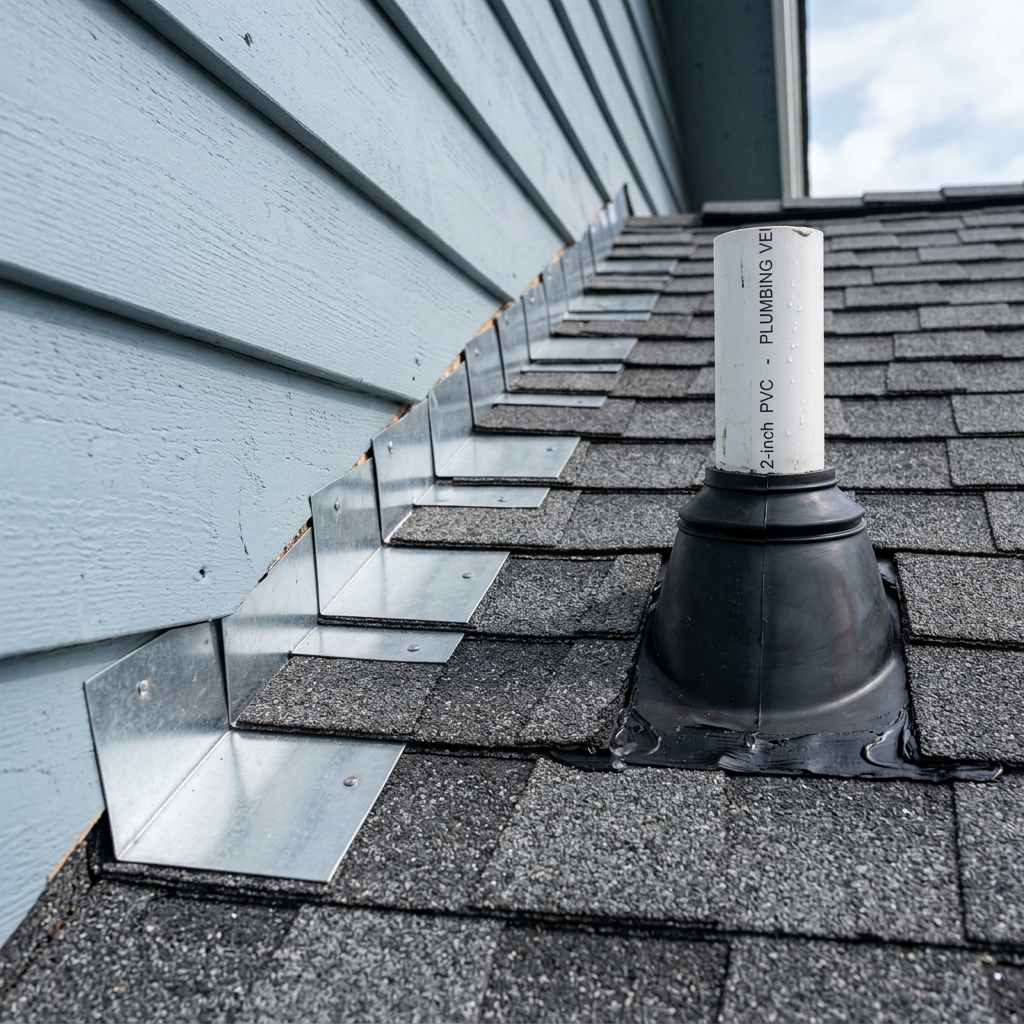
Over 90% of roof leaks occur at penetrations or flashing transitions, not in the middle of a shingle field. Understanding flashing is the single most important diagnostic skill for eliminating leaks.
Pipe Boot Flashings
Every plumbing vent pipe (those PVC pipes sticking up through your roof) requires a rubber “boot” that seals around the pipe. The rubber deteriorates in UV exposure over 10–15 years, cracks, and allows water to pour straight down the pipe into your interior walls. Replacing a pipe boot is a $150–$250 job for an independent roofer. Corporate companies will use a cracked pipe boot as justification for a $15,000 full re-roof.
Step Flashing (Wall-to-Roof Transitions)
Where a sloped roof meets a vertical wall (dormers, second-story additions), individual L-shaped pieces of aluminum or galvanized steel are woven into each course of shingles. This is called step flashing. Kickout flashing must be installed at the bottom of every step-flashing run to divert water into the gutter instead of allowing it to run down the siding. Missing kickout flashing is the #1 cause of rotting exterior wall sheathing in Spokane homes with dormers.
Valley Flashing
Roof valleys (the V-shaped channel where two slopes converge) concentrate massive volumes of running water. There are two methods: Open Valleys use exposed W-shaped metal flashing with shingles cut back 3″ on each side. Closed Valleys weave or overlay the shingles across the valley with ice & water shield beneath. Open metal valleys last longer and are easier to maintain but cost more to install. Both methods are code-compliant.
7. Gutters & Water Management
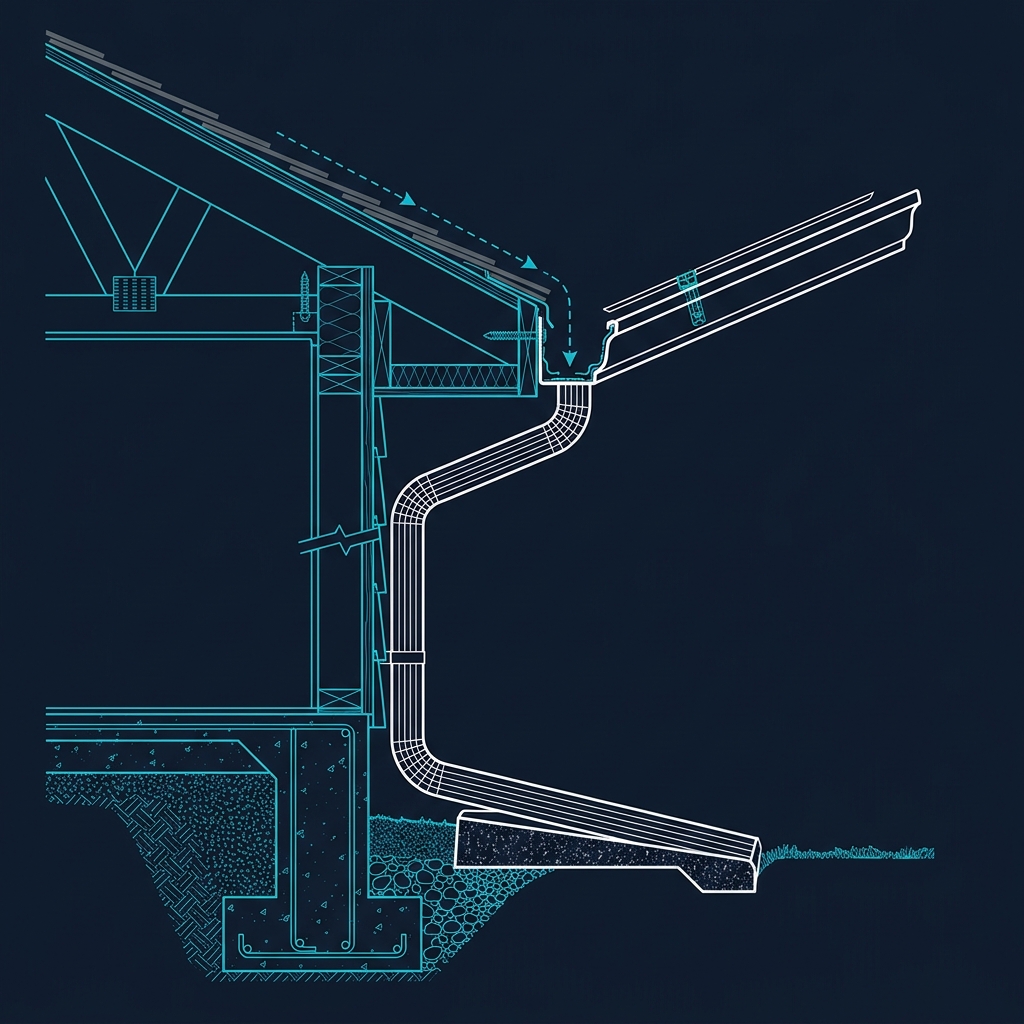
A gutter system has exactly one job: collect roof water runoff and discharge it at least 6 feet away from the foundation. When gutters fail, fail to drain, or are absent entirely, the water pours directly against the foundation walls. In Spokane’s freeze-thaw climate, this is the direct cause of cracked foundations, flooded crawlspaces, and catastrophic erosion under footings.
Seamless Aluminum (5-Inch K-Style)
The industry standard. Formed on-site from a continuous coil of .027-gauge aluminum with zero seams (seams are the failure point where clogs begin). Seamless gutters should cost $6–$10 per linear foot installed in Spokane. Downspouts should be placed every 30–40 feet and discharge into underground drain tile or splash blocks extending 6+ feet from the house.
Gutter Guards: The Upsell
Gutter guard companies will charge $3,000–$5,000 to install micro-mesh or solid-surface guards over your gutters, claiming you will “never clean them again.” The reality: pine needles, Spokane cottonwood seed pods, and volcanic ash residue all accumulate on top of the guards, eventually blocking water from entering the gutter at all. Leaf guards reduce cleaning frequency but do not eliminate it. A $200–$300 annual cleaning by a handyman is almost always more cost-effective than a $5,000 guard system.
8. The Homeowner’s Self-Inspection Guide
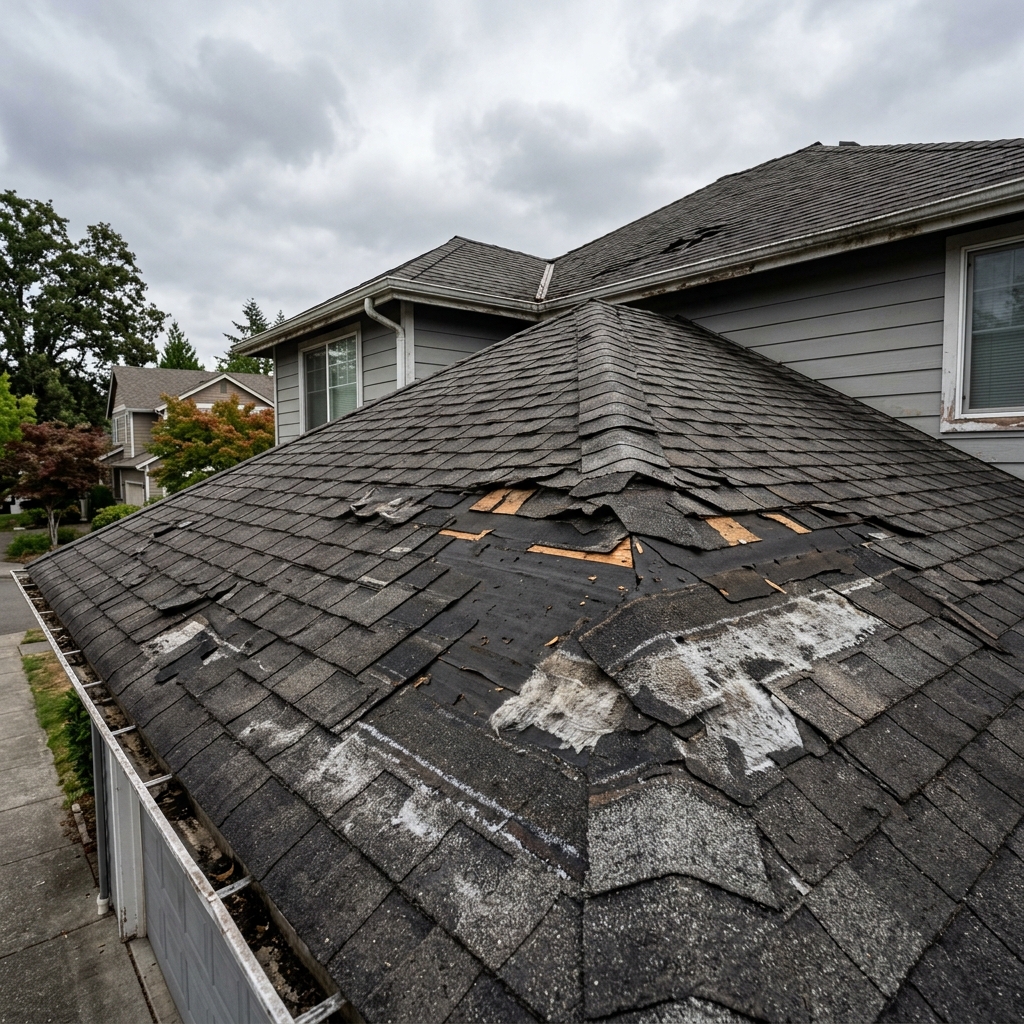
You do not need to climb on your roof to assess its condition. Here is a systematic interior and ground-level inspection checklist that will tell you 90% of what a professional inspector would find.
From the Attic (The Truth Chamber)
- Look for daylight visible through the deck boards. Any light = a hole.
- Check for dark staining or water trails on the underside of the sheathing, especially around chimney/vent penetrations.
- Feel the insulation. If it is damp, matted, or compressed, moisture is entering from above.
- Look for black mold on the underside of the roof deck. This indicates chronic condensation from poor ventilation.
- Check that bathroom exhaust fans are ducted to the exterior, not venting directly into the attic (extremely common in Spokane homes pre-2000).
From the Ground (Binoculars)
- Granule loss: Look at your downspout discharge area. If you see piles of dark, sand-like granules accumulating, your shingles are actively shedding their protective surface.
- Curling or lifting: Shingles that curl upward at the edges are losing adhesion and are vulnerable to wind blow-off.
- Missing shingles: After every major windstorm, walk your yard and check your driveway. Finding shingle tabs on the ground means your roof is actively failing.
- Sagging ridgeline: If the peak of your roof visibly dips or sags, the ridge board or structural trusses may be compromised. This requires immediate structural evaluation.
9. Insurance Claims: How the Game Works
Spokane experiences hail events, windstorms, and heavy snow loads every single year. Understanding how your homeowner’s insurance actually processes a roof claim is the difference between getting a free roof and getting scammed out of thousands.
RCV vs ACV Policies
Replacement Cost Value (RCV): The insurance company pays the full cost to replace your roof with equivalent materials at today’s prices, minus your deductible. This is the good policy.
Actual Cash Value (ACV): The insurance company depreciates the value of your roof based on its age. If your 20-year shingle is 15 years old, they depreciate it 75% and pay you almost nothing. Check your declarations page immediately.
The Supplement Process
The initial insurance adjuster’s estimate is almost always deliberately low. They use software called Xactimate that calculates material and labor at national averages. Spokane labor costs and material delivery logistics exceed national averages. A competent, independent roofer will file a “supplement”—a detailed, line-item rebuttal matching the exact Xactimate codes the adjuster used, proving the true local cost. This frequently adds $2,000–$5,000 back to your claim. Any roofer who does not know how to file a supplement is leaving your money on the table.
WARNING: “We’ll Cover Your Deductible”
If ANY roofing company tells you “Don’t worry, we’ll cover your deductible” or “We’ll pay your deductible for you”—this is outright insurance fraud under Washington State law (RCW 48.30.230). The contractor inflates the claim amount to absorb the deductible cost, which constitutes filing a false claim. Your insurance company can drop your policy, and the contractor can lose their license. Walk away immediately.
10. The Extortion Tactics Library
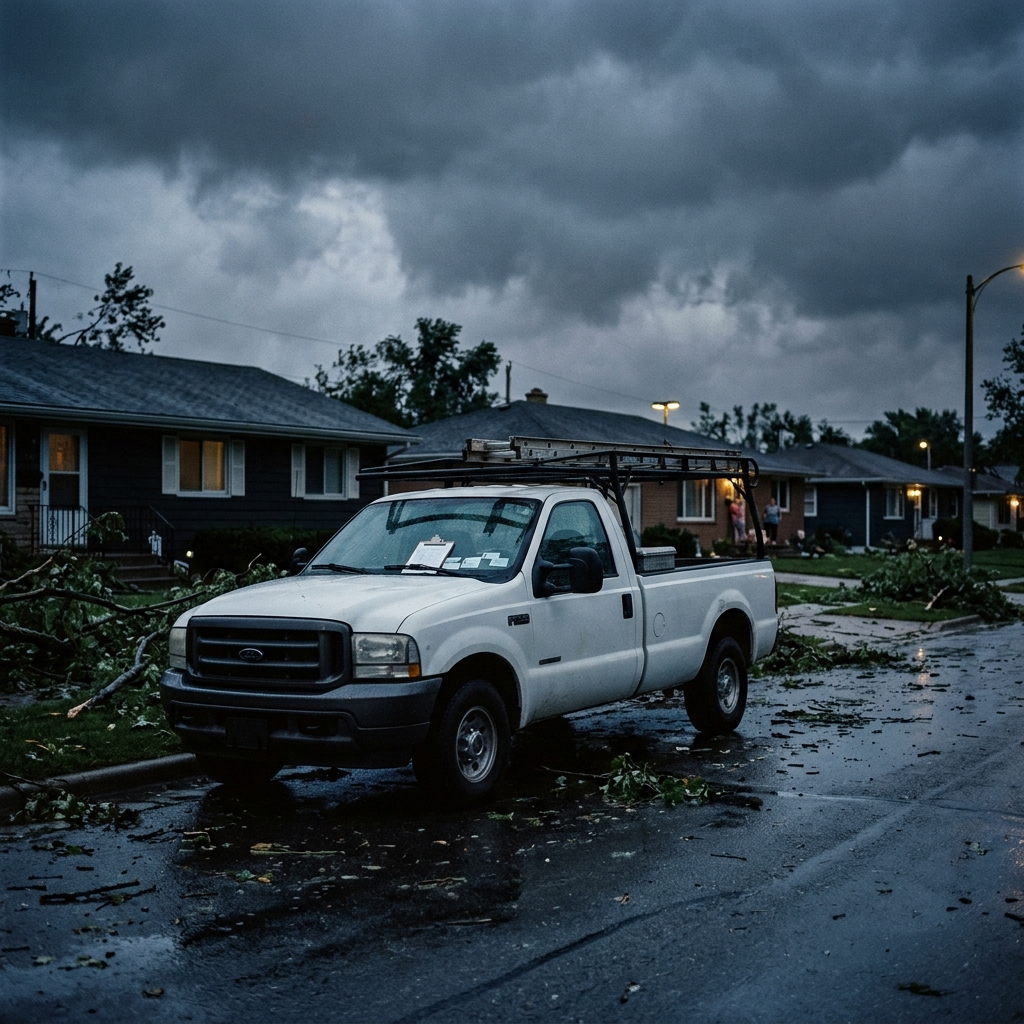
The roofing industry has the highest concentration of predatory contractors in all of residential construction. After every significant weather event, “storm chasers”—out-of-state crews with unmarked trucks and no local Washington State contractor license (RCW 18.27)—flood into Spokane neighborhoods knocking on doors. Here are the documented tactics they use.
The “Free Inspection” Door Knock
The Tactic: A clean-cut guy in a polo shirt knocks on your door 48 hours after a hailstorm and says, “Hey, we’re doing free storm damage inspections in the neighborhood. Your neighbors at 1245 already filed a claim. Mind if I take a quick look?” He climbs up, takes photos, comes back down and shows you “hail hits” on his phone that could be normal weathering or granule loss from age.
The Reality: This person often works on commission. They are not inspecting your roof for your benefit; they are prospecting for insurance claims they can file and profit from. Many storm chasers use a technique called “manufacturing damage”—they quietly drag a tool or their boot across shingles while on the roof to create fresh marks that look like hail impact.
The “Sign Now Before the Adjuster Comes” Pressure
The Tactic: The storm chaser presents you with an “Assignment of Benefits (AOB)” or “Contingency Agreement” and pressures you to sign it immediately. The contract gives them the legal right to negotiate directly with your insurance company on your behalf—and you cannot cancel.
The Reality: Once you sign an AOB, you have signed over control of your insurance claim. They can inflate costs, change material specs, add charges, and you have zero recourse. NEVER sign a contract before your insurance adjuster has physically inspected the roof. Washington State law (SB 5483) has placed restrictions on AOBs, but out-of-state chasers frequently ignore them.
The “Lay-Over” Shortcut
The Tactic: Instead of tearing off your existing shingles down to the deck (which is the only way to inspect the sheathing for rot), the company installs the new shingles directly on top of the old layer. They call it a “re-cover” or “overlay.” This saves them an entire day of labor and dump fees ($800–$1,200 in disposal costs they pocket).
The Reality: A second layer of shingles traps moisture against the old layer, accelerating rot. It adds 250–300 lbs per square of dead weight to your trusses (which were engineered for one layer). It voids most manufacturer warranties. And Washington State building code only allows a maximum of 2 layers total—meaning the next roofer will have to tear off BOTH layers, doubling the future tear-off cost. Always demand a full tear-off to bare deck.
The “Lifetime Warranty” Illusion
The Tactic: The sales rep emphasizes a “Lifetime Manufacturer Warranty” repeatedly to justify their premium pricing, making you feel like the roof is guaranteed forever.
The Reality: Read the fine print. Manufacturer warranties (GAF, Owens Corning) are pro-rated after 10 years, meaning they depreciate the replacement value year-over-year. By year 20, the warranty covers almost nothing. The warranty also ONLY covers defective shingles—not labor, not tear-off, not flashing, not ice shield, not ventilation. The actual “Lifetime” only refers to the “reasonable lifetime” of the shingle, which GAF defines as 25–30 years, not your lifetime. Furthermore, the warranty is 100% void if the installer did not follow the manufacturer’s exact specification to the letter.
The High-Pressure Financing Trap
The Tactic: “Great news! We can finance the entire roof at 0% interest for 18 months! Just sign here.” The sales rep presents GreenSky or Mosaic financing as if it’s free money.
The Reality: The 0% is a deferred-interest promotional rate. If you do not pay the full balance within the 18-month window, all of the deferred interest (often 22–28% APR) is retroactively applied to the original balance from day one. On a $15,000 roof, that is $3,000–$4,000 in sudden interest charges. The contractor doesn’t care because they received full payment from the financing company on day one. They are monetizing your debt.