The Complete Septic System Encyclopedia
This is the most comprehensive septic system guide published on the internet. Built from EPA engineering manuals, Washington State Department of Health regulations, and the raw field experience of independent Spokane County pumpers. Every homeowner on a septic system should read this cover to cover.
T-shaped PVC or concrete structures called baffles exist at both the inlet and outlet of the tank. They are the most important structural components in the entire system.
Inlet Baffle: Forces incoming high-velocity wastewater downward into the effluent zone, preventing it from violently stirring up the settled sludge layer. Without it, every toilet flush would re-suspend settled solids.
Outlet Baffle: Reaches deep into the clear effluent zone (typically 12-18 inches below the waterline), ensuring that floating scum cannot cross over into the drainfield. This is the single most critical component. If an outlet baffle rots away (common in 1980s concrete tanks where the original concrete tee deteriorated), raw grease will flow directly into the drainfield and permanently destroy it within months.
Inspection Tip: Every time your tank is pumped, ask the pumper to visually inspect the outlet baffle. A missing or deteriorated baffle can be replaced with a PVC tee for approximately $150-$250 — versus $20,000+ for a new drainfield if it fails silently.
A modern upgrade that should be standard on every septic system: an effluent filter is a slotted cylindrical cartridge installed inside the outlet baffle. It acts as a physical strainer, catching any solids that might otherwise escape into the drainfield.
Cost: $80-$150 installed. Maintenance: Must be pulled out and sprayed clean with a garden hose every 1-2 years during pumping. If you neglect cleaning, the filter clogs and wastewater backs up into your house — but this is actually the filter doing its job correctly. It is forcing a manageable backup rather than allowing an undetectable, permanent drainfield failure.
Bottom Line: An effluent filter is the cheapest insurance policy in home ownership. A $30 filter cartridge can prevent a $25,000 drainfield replacement.
Bedrooms Served: 1-2 Bedrooms
Capacity (Gallons): 750 - 1,000
Pump Frequency: Every 2-3 Years
Bedrooms Served: 3 Bedrooms
Capacity (Gallons): 1,000 - 1,250
Pump Frequency: Every 3-4 Years
Bedrooms Served: 4-5 Bedrooms
Capacity (Gallons): 1,250 - 1,500
Pump Frequency: Every 3-5 Years
Bedrooms Served: Multi-Unit / Restaurant
Capacity (Gallons): 2,000 - 5,000+
Pump Frequency: Every 1-2 Years
3. The Biological Engine: Anaerobic Digestion
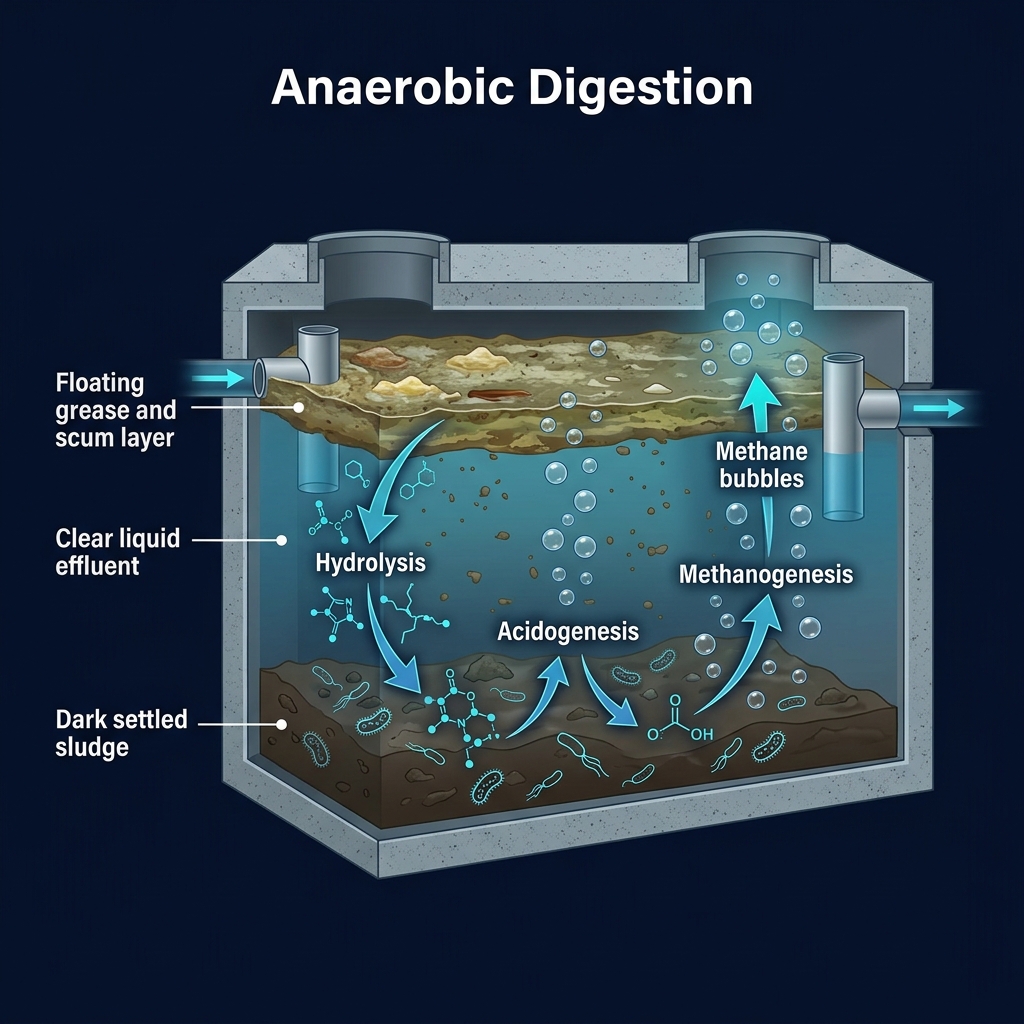
Your septic tank is not a storage container. It is a living biological reactor. Trillions of anaerobic bacteria (organisms that thrive in oxygen-free environments) continuously digest the organic fraction of your wastewater. This process, called anaerobic digestion, breaks down complex organic molecules into simpler compounds: methane gas, carbon dioxide, water, and mineral residue.
How the Bacteria Work
The digestion process occurs in three sequential stages:
- Hydrolysis: Enzymes break down large organic molecules (proteins, fats, carbohydrates) into smaller soluble compounds.
- Acidogenesis: Acid-forming bacteria convert these compounds into volatile fatty acids, alcohols, hydrogen, and carbon dioxide.
- Methanogenesis: Methane-producing archaea (ancient single-celled organisms) convert the acids into methane (CH₄) and CO₂. This is why septic tanks sometimes emit a faint "rotten egg" smell — hydrogen sulfide (H₂S) is a natural byproduct.
The following substances will massacre your bacterial colony, effectively "shutting off" digestion and causing rapid sludge buildup: Bleach (more than 1/4 cup per load), antibacterial soaps, paint thinner/solvents, prescription medications (especially antibiotics flushed down the toilet), and chemical drain cleaners (Drano, Liquid-Plumr). Normal household detergent in reasonable quantities is fine — the bacteria are resilient. But a single bottle of bleach poured down the drain can sterilize the tank for weeks.
It is universally agreed upon by civil engineers and the EPA that store-bought septic "enzyme" additives (Rid-X, Zep, etc.) are unnecessary. A healthy human body introduces billions of perfectly calibrated bacteria into the system every single day for free. Some additives actually harm the system by re-suspending settled sludge, causing solids to flow into the drainfield. Save your $12/month.
4. Drainfield Science: Soil Percolation & The Biomat
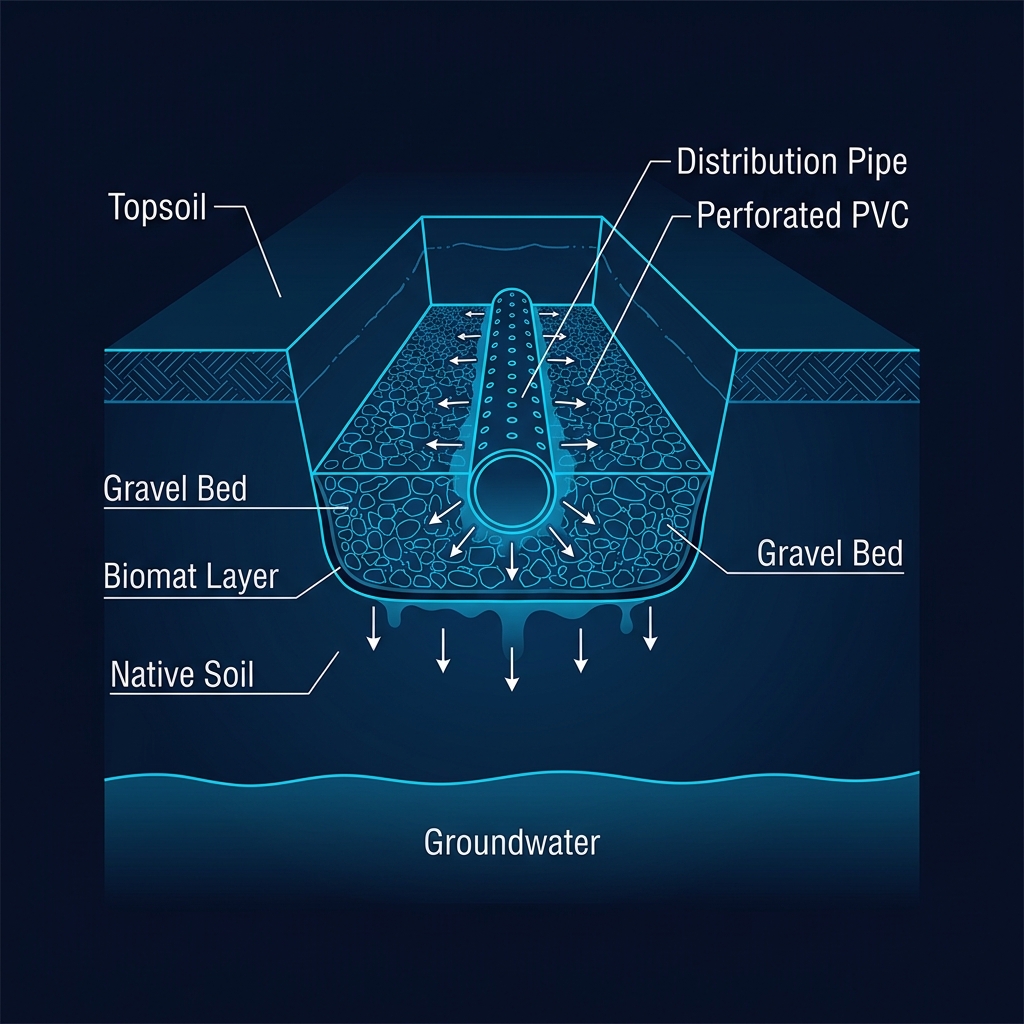
The tank provides "Primary Treatment" (physical settling). The soil beneath the drainfield provides "Secondary Treatment" (biological purification). Your drainfield is where the real science happens — and it is the component you absolutely cannot afford to destroy.
The Percolation Test (Perc Test)
Before any septic system is permitted, an engineer digs test holes on the property and measures how fast water drains through the native soil — the Soil Absorption Rate (SAR). Sandy soils drain fast (good). Clay soils drain agonizingly slowly (bad). The total square footage of drainfield trench required is mathematically calculated based on this rate and the expected daily wastewater volume.
The Biomat: The Invisible Living Filter
At the exact interface between the gravel trench and the native soil, an invisible biological entity called the biomat forms over time. This dark, slimy layer of anaerobic bacteria acts as the ultimate filter, consuming pathogens, nitrogen, and phosphorus before they reach the local groundwater aquifer. A healthy biomat is approximately 1-2 inches thick and maintains equilibrium — growing at the same rate it decomposes.
If you fail to pump your tank on schedule, high-nutrient sludge escapes through the outlet and flows into the drainfield trenches. The biomat gorges on this concentrated food source and multiplies exponentially, growing to 6+ inches thick. At this point, water can no longer percolate through it. The trenches permanently flood. Sewage surfaces in your yard. This is called "Hydraulic Failure" and the only cure is complete excavation and replacement of the entire drainfield.
The perforated pipes are buried only 18-36 inches below the surface. Vehicle weight compacts the soil, destroying the microscopic pores required for water absorption, and can physically crush the distribution pipes. ATVs, trucks, and even riding mowers during wet conditions can cause irreversible compaction damage. Treat the grass above your drainfield like sacred ground.
5. Pumping Intelligence
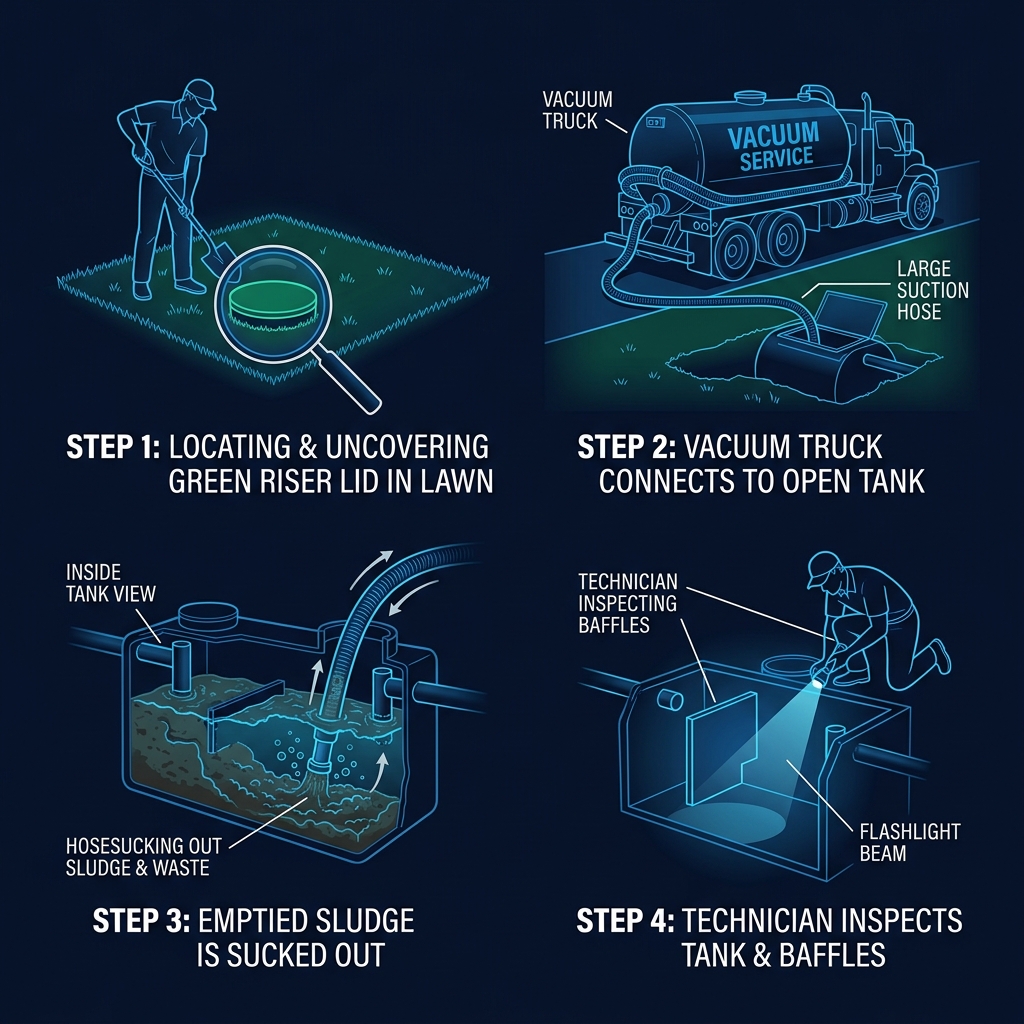
Pumping is the single most important maintenance action a septic homeowner performs. The vacuum truck extracts the accumulated sludge and scum layers, resetting the tank's capacity and preventing solids from escaping into the drainfield.
The EPA recommends pumping every 3-5 years for a typical household. However, the actual interval depends on four variables:
1. Tank Size: A 1,000-gallon tank fills faster than a 1,500-gallon tank (obvious, but often ignored).
2. Household Size: A family of 5 produces roughly 300 gallons/day of wastewater. A single person produces ~70 gallons/day. More people = faster sludge accumulation.
3. Garbage Disposal Use: Homes with heavy garbage disposal use may need pumping every 18-24 months. Food solids do not break down efficiently in a septic environment.
4. Water Usage Habits: High-efficiency toilets (1.28 GPF) and front-load washers dramatically reduce the hydraulic load on the system, extending pump intervals.
A qualified pumper should perform the following during every service visit:
- Locate and expose the tank lids (or access via risers if installed)
- Measure the scum and sludge layers before pumping to assess accumulation rate
- Pump the tank completely empty — both compartments if dual-chamber
- Visually inspect the inlet and outlet baffles for deterioration or blockage
- Check the effluent filter (if installed) and clean it
- Inspect the tank walls for cracks, root intrusion, or structural damage
- Backflush the outlet line toward the drainfield to check for flow
- Provide a written report documenting findings and recommended next pump date
If your pumper simply sticks a hose in, pumps for 10 minutes, and drives away without inspecting anything — you hired the wrong company.
Fair Price (Spokane Market): $750 - $1,000
Red Flag Price: Below $200 (cutting corners) or above $1,200 (price gouging)
Fair Price (Spokane Market): $100 - $300
Red Flag Price: Above $500
Fair Price (Spokane Market): Included with pump
Red Flag Price: Charged separately as a $150+ "add-on"
Fair Price (Spokane Market): Included with pump
Red Flag Price: Charged separately
Fair Price (Spokane Market): $800 - $1,200
Red Flag Price: Above $2,000
6. The Non-Negotiable Golden Rules
The single greatest point of consensus among veteran pumpers and civil engineers: a septic system requires strict input management. Do not treat your drains like a municipal sewer.
The Resulting Catastrophe: They do not dissolve. They form massive dreadlock-like clogs that jam effluent pumps or block your baffle wall entirely. Never flush them.
The Resulting Catastrophe: Food solids do not break down fast enough in anaerobic conditions. Disposals drastically inflate the sludge layer, cutting your 3-year pumping cycle down to 18 months.
The Resulting Catastrophe: Grease cools, coagulates, and floats to form the scum layer. Excessive grease suffocates the bacteria and can flow directly into the drainfield.
The Resulting Catastrophe: 6 loads in a single day floods the system with ~250 gallons, forcing undigested solids into the drainfield before settling can occur. Space your water usage.
The Resulting Catastrophe: Drano and Liquid-Plumr contain sodium hydroxide (lye), which sterilizes your bacterial colony on contact. Use a drain snake instead.
The Resulting Catastrophe: Brine backwash (salt water) disrupts the specific gravity balance, re-suspending settled sludge. Route water softener discharge away from the septic system if possible.
7. System Types: Aerobic vs. Anaerobic Topology
Not all properties possess the soil depth or porosity to support traditional gravity-fed anaerobic designs. Engineers utilize varying mechanical architectures to compensate for geological limitations.
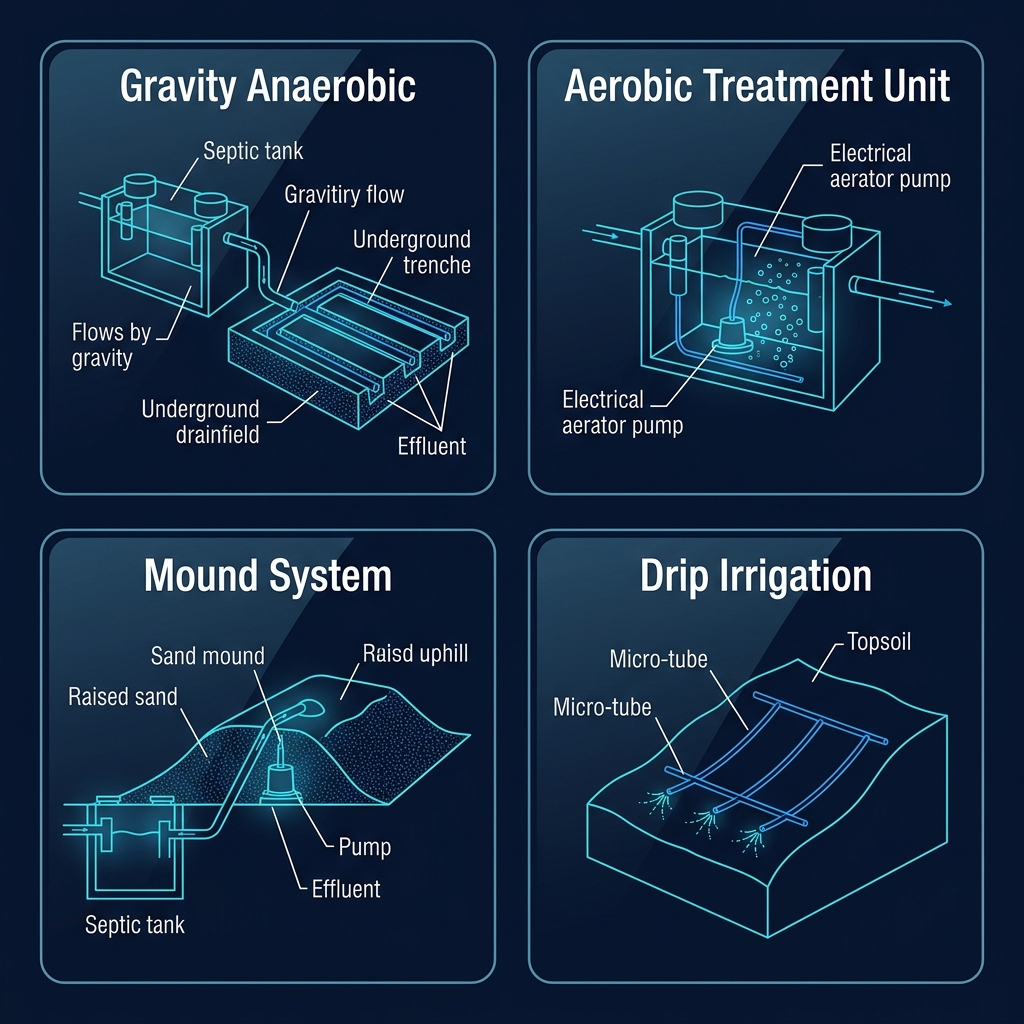
Engineering Profile: Standard system. Relies on absence of oxygen and gravity. Requires 3-4 feet of highly permeable, unsaturated soil beneath the drainfield.
Maintenance & Failure Vectors: Low maintenance. Longest lifespan. Fails due to abuse, sludge crossover, or root intrusion.
Engineering Profile: Miniature municipal plant. Uses an electrical aerator to pump oxygen into the tank, hyper-accelerating bacteria growth and producing cleaner effluent.
Maintenance & Failure Vectors: High maintenance. Requires annual service contracts. Electrical aerator failure causes instant system septic shock.
Engineering Profile: Used when bedrock or groundwater is too high. Effluent is pumped UP into an artificial sand mound built above ground level.
Maintenance & Failure Vectors: Relies on an electric effluent pump and floats. Pump failure triggers alarm; must be addressed within 24 hours.
Engineering Profile: Micro-tubing evenly disperses treated effluent inches below the topsoil. Often used on extreme slopes.
Maintenance & Failure Vectors: Exceedingly vulnerable to untreated solids. Effluent filters must be cleaned aggressively to prevent micro-clogs.
Engineering Profile: Effluent passes through a constructed sand bed (lined box) for additional treatment before reaching the drainfield.
Maintenance & Failure Vectors: Produces very high-quality effluent. Requires periodic sand replacement ($3,000-$5,000) every 15-20 years.
8. Tank Materials & Lifespan
A septic tank is not a permanent utility. It is an actively degrading structure with a finite mechanical lifecycle dictated by its construction material and the corrosive chemistry of decomposing sewage.
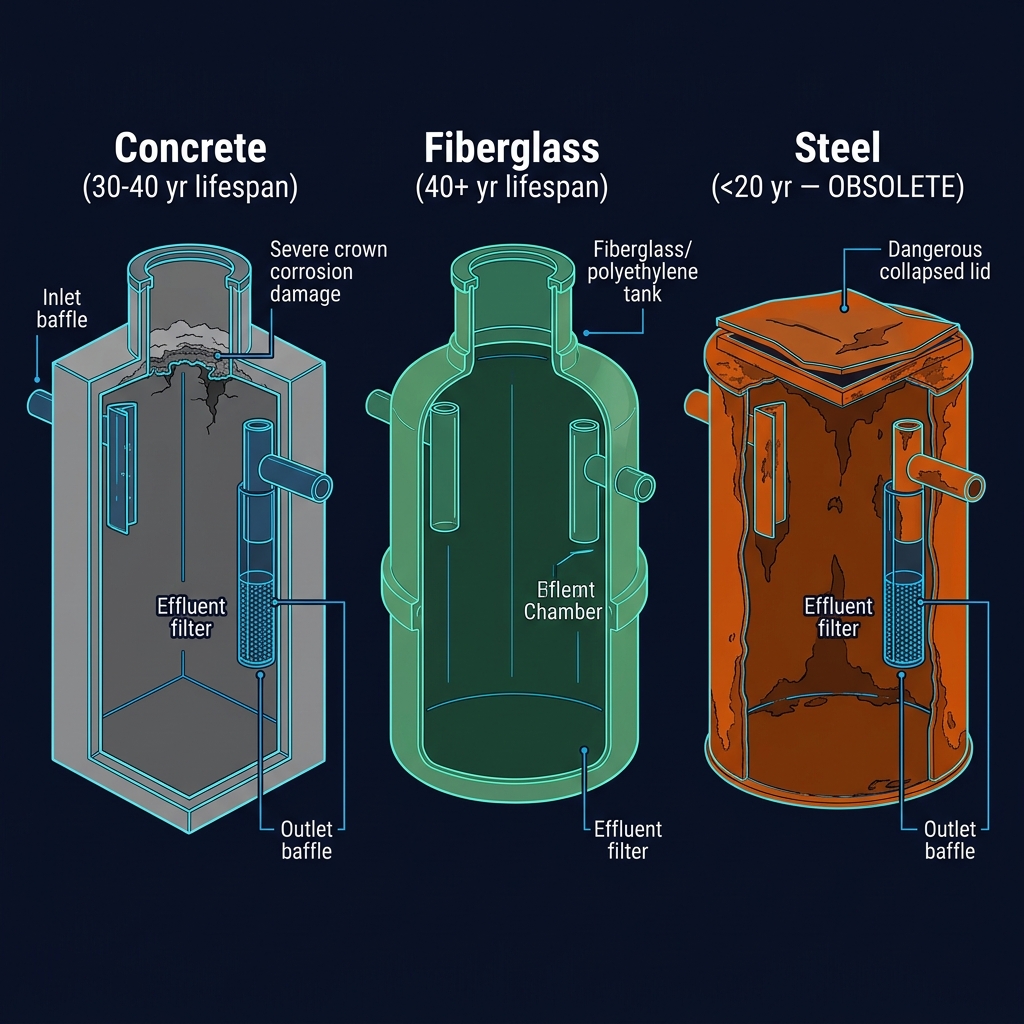
The gold standard. Heavy (8,000-12,000 lbs), immovable, and structurally resilient. However, hydrogen sulfide gas (H₂S) naturally produced by anaerobic digestion rises to the ceiling of the tank, converts to sulfuric acid in the presence of moisture, and systematically eats away the concrete from the inside out. This process is called Crown Corrosion.
Signs of Failure: Visible crumbling or "stalactite" formations hanging from the concrete ceiling during pumping. A severely corroded lid that cracks under the weight of a person stepping on it.
Mitigation: Some modern tanks use acid-resistant coatings on the interior ceiling. Proper ventilation (allowing H₂S to escape rather than concentrate) slows corrosion significantly.
Impervious to sulfuric acid corrosion. Lightweight (400-600 lbs), which makes installation easier and cheaper. However, their light weight creates a unique vulnerability: if the tank is pumped completely empty when the surrounding water table is high (common during Spokane's spring thaw), physics dictates the empty tank can float upward out of the ground like a boat — snapping inlet/outlet pipes and destroying the entire system.
Prevention: Qualified pumpers in high-water-table areas will leave 6-12 inches of water in the bottom of a fiberglass tank after pumping to add ballast weight.
Commonly installed prior to 1980. Steel tanks suffer from severe oxidative rusting from both inside (sulfuric acid) and outside (soil moisture). The lid is the first component to fail — it rusts through completely and collapses inward, creating a literal deadly sinkhole in your yard. Children and pets have fallen into collapsed steel tank lids.
If you have a steel tank, replacement is not optional — it is urgent. Contact Spokane County Health District to begin the permitting process for a concrete or fiberglass replacement.
9. Risers & Access Upgrades
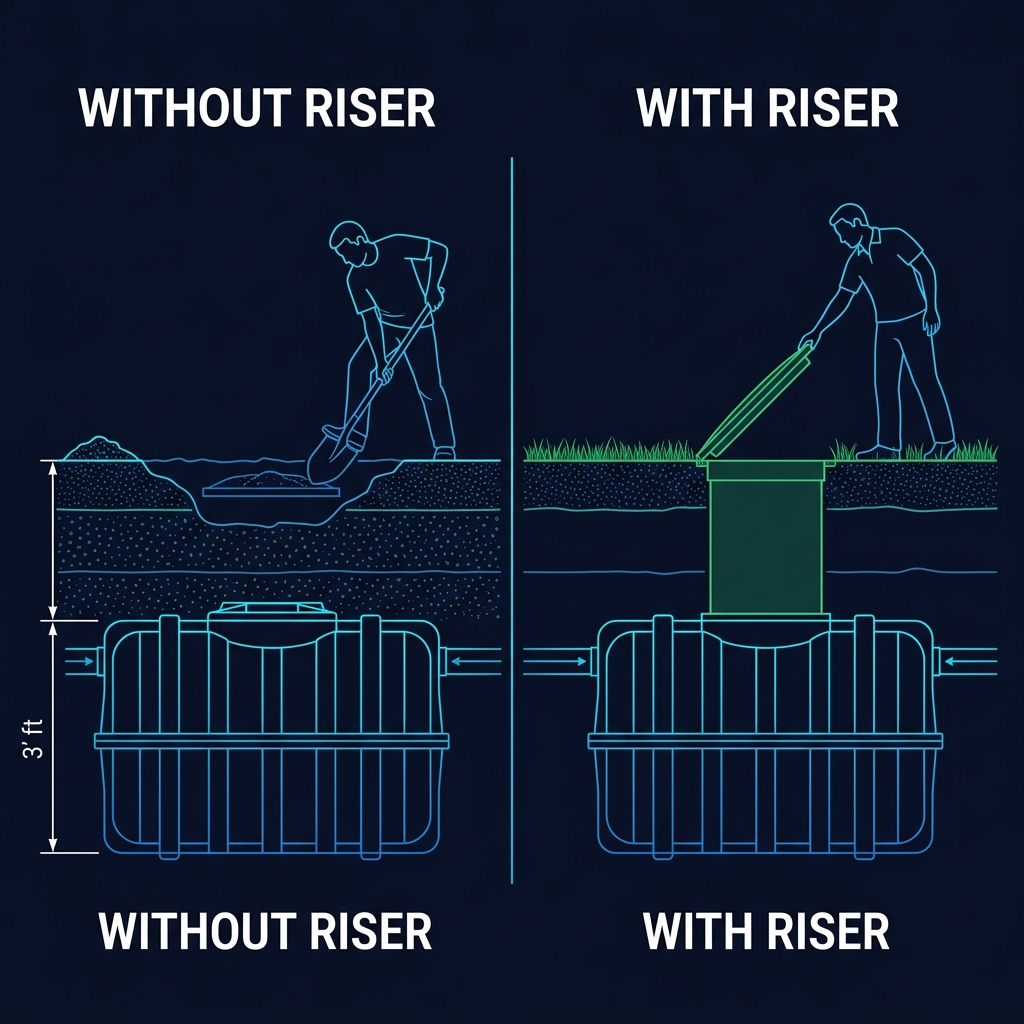
If your septic tank lid is buried 2-3 feet underground, you are paying a "dig fee" — typically $150-$300 — every single time a pumping company visits. Over the life of the system, this adds up to thousands of dollars in wasted excavation.
A riser is a PVC or poly cylinder installed on top of the existing tank opening, extending the access point to ground level (flush with the grass). A sealed, screw-on green lid sits at the surface. Total installed cost: $300-$600.
ROI Calculation
Without Risers: $200
With Risers: $0
Without Risers: 7 pumps × $200 = $1,400
With Risers: $0 in dig fees
Without Risers: $0
With Risers: $450 (one-time)
Without Risers: —
With Risers: $950 saved
Beyond cost savings, risers provide emergency access. When sewage is backing up into your bathtub at 2 AM on a frozen January night, the pumper can access your tank in minutes instead of spending 45 minutes jackhammering through frozen earth.
10. Warning Signs: Identifying Disaster Early
Ignore these signals at your own financial peril. A failing system does not announce itself with a single dramatic event — it whispers warnings for weeks before total failure.

If your toilet gurgles audibly when the shower is draining, or you hear bubbling from floor drains when the washing machine empties, the main trunk line or tank baffle is restricted. Air is being displaced backward through the plumbing stack because water cannot exit the system fast enough. Call an independent pumper immediately.
If there is a perfectly rectangular patch of vibrant, wildly lush green grass over your drainfield during the dead of a dry Spokane summer — while the rest of the yard is brown — your drainfield is failing and pushing raw, nutrient-dense sewage directly to the surface. This is not your lawn thriving. This is your system dying.
Walking over the tank area and feeling a structural "squish" indicates one of two things: a cracked or collapsed tank lid allowing surface water to saturate the soil above, or a tank that is completely full and overflowing through the seams. Either scenario requires immediate professional assessment.
A single slow drain is usually a localized clog (hair, soap buildup). But if every drain in the house is slow simultaneously — toilets, sinks, showers, and the washing machine — the problem is downstream. Either the tank is completely full and needs pumping, or the outlet to the drainfield is blocked. This is a system-wide hydraulic issue, not a plumbing issue.
A properly functioning septic system should produce zero detectable odor at ground level. If you smell rotten eggs or sewage near the tank or drainfield area, gas is escaping — typically through a cracked tank lid, a failed wax ring on a vent pipe, or a compromised cleanout cap. Persistent outdoor odor near the drainfield specifically indicates surface-level effluent breakout (system failure in progress).
11. Spokane County Regulations & Real Estate
Real estate transactions involving Onsite Sewage Systems (OSS) are strictly regulated by the Spokane Regional Health District (SRHD) to prevent buyers from inheriting a $25,000 environmental hazard.
Time-of-Transfer Inspections
In Spokane County, a seller is legally required to have the septic system inspected and provide a Report of System Status (ROSS) or equivalent certification before closing. This is not optional — mortgage lenders and title companies will not proceed without it.
The inspector will deliberately introduce 100-200 gallons of water into the system within a 30-minute window to simulate high-stress conditions (like an aggressive laundry day + multiple showers). If the drainfield level rises and fails to recede within the observation window, the field has failed laterally and the system fails inspection.
The Vacant Home Trap: Never allow an inspector to simply "look at" a tank on a home that has been vacant for 6+ months. Failing drainfields appear perfectly functional when completely dry. Only a hydrostatic flow test under simulated load proves operability.
The physical layout of the tank and drainfield must match the county "As-Built" records on file with SRHD. Unpermitted additions — extra bedrooms, a mother-in-law suite, or an undocumented drainfield extension — will flag the transaction, forcing escrow holdbacks or killing the mortgage underwriting entirely.
Pro Tip: Before listing a septic property for sale, request your As-Built drawing from SRHD and compare it to the actual system. Fix discrepancies before listing — don't let a buyer's inspector discover them during due diligence.
12. The Extortion Tactics Library
Documented manipulation tactics used by corporate and Private Equity-owned septic companies to extract maximum revenue from homeowners.
The Pitch: During pumping, the tech "discovers" a crack in the tank wall and recommends a complete $15,000 tank replacement immediately.
The Truth: Hairline cracks in concrete tanks are extremely common and usually structurally insignificant. Concrete naturally develops micro-cracks due to soil pressure and freeze-thaw cycles. A crack that is actively leaking groundwater INTO the tank (visible during pumping) is concerning because it's overloading your drainfield with clean groundwater. But a hairline surface crack in the wall does not warrant a $15,000 replacement. Get a second opinion from a licensed septic inspector — not the pumper who wants to sell you a new tank.
The Pitch: "Your bacteria levels are dangerously low. You need our proprietary $200 'Bio-Restore' treatment injected into the tank right now, and then a $30/month maintenance additive subscription."
The Truth: There is no field-portable test that accurately measures bacterial health inside a septic tank. Any company claiming to "test your bacteria levels" during a standard pump-out is fabricating data to sell recurring product subscriptions. Your body replenishes the tank with billions of bacteria daily. Save $560/year.
The Pitch: "We recommend annual pumping to keep your system healthy. Let's set up a yearly service plan for $400/year."
The Truth: The EPA and every state health department recommends pumping every 3-5 years for a typical household. Pumping annually is not only wasteful ($400/year × 30 years = $12,000 in unnecessary costs), it can actually be counterproductive because you're removing the healthy bacterial colony that hasn't had time to fully colonize and digest waste. The only exception is extremely small tanks (500 gal) or households with 5+ occupants.
The Pitch: A suspiciously cheap pumping company ($150-$200) arrives, inserts the vacuum hose through only one access point, pumps for 10 minutes, and declares the job done.
The Truth: They only pumped the liquid from the first compartment. The heavy sludge layer at the bottom — which is the entire reason you're pumping — was barely disturbed. And the second compartment (if you have a dual-chamber tank) was never touched at all. A proper pump-out requires exposing both lids, pumping both compartments completely, and using the hose to break up and extract the compacted sludge at the bottom. If it takes less than 20-30 minutes, they shortcut you.